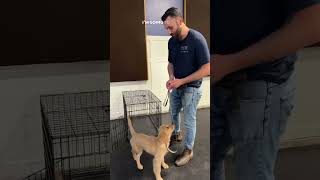
Loose leash walking means your dog stays beside you with a slack line instead of dragging you down the street. This guide suits any age or breed, and it works best with short daily sessions and a pocket full of small, smelly treats. You only need a flat leash, a collar or front-clip harness, and a quiet starting spot.
YouTube video: How to train your how to walk nicely on leash #dogtraining #dogtrainer #dogtrainingtips
Caption availability is unknown. Check the CC control in the YouTube player.
- Video length
- 1 min 1 s
- Time to do it
- 10 minutes per session
- Difficulty
- Easy
- Steps
- 8
What you need
Steps
Clip the leash to a flat collar or a front-clip harness. Skip choke chains, slip leads and retractable leads, which tighten or pull back against your training.
Load your pocket with pea-sized treats your dog really wants. Chicken, cheese or freeze-dried liver work better than plain kibble for outdoor distractions.
Start somewhere boring, like a driveway or quiet pavement. Walk a few steps and mark the moment your dog is beside you with a calm yes, then give a treat.
Feed the treat right at your leg, not in front of your dog. That teaches your dog that the good spot is next to you, not out ahead.
The instant the leash goes tight, stop moving. Stand still like a post and wait for your dog to look back or step toward you, then reward and walk on.
Change direction often, without warning. Turn and walk the other way so your dog has to watch you instead of pulling toward a smell or another dog.
Practice 5 to 10 minutes at a time, two or three times a day. End every session while your dog is still getting it right, not after it all falls apart.
Add distractions slowly, such as passing a driveway, then a parked car, then another dog across the street. Drop back a step if pulling returns.
Tips and common mistakes
Never yank or jerk the leash; stopping your feet is enough to show your dog that pulling gets nothing.
Keep the leash loose and your hand still, because a tight leash actually invites a dog to pull harder.
Reward often at first, roughly every few steps, then fade to random treats once walking stays slack.
Pick one side for your dog to walk on and stick to it so the picture stays clear.
Questions
How long does it take to stop the pulling?
Most dogs need a few weeks of short daily sessions before loose walking becomes a habit. Puppies and strong pullers often take longer, so keep sessions brief and consistent.
Should I use a harness or a collar?
A front-clip harness gives you more control with a heavy puller and does not press on the throat. A flat collar is fine for a dog that already walks calmly.
What if my dog ignores the treats outside?
Your treats are not exciting enough or the area is too distracting. Move to a quieter spot and use something smellier, like cooked chicken, until your dog checks in again.
The notes are drafted automatically from video details and general task knowledge. How the guide was prepared
Report a correction