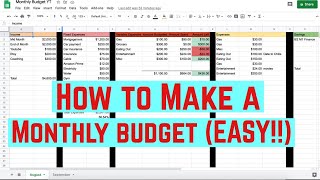
You will set up a month-by-month budget planner in Google Sheets, add your accounts and bills, log spending as it happens and see what is left at the end of the month. It suits beginners who want income, expenses and savings in one place instead of scattered notes. You need a budget template and your recent bank statements.
YouTube video: How to Use the Ultimate Monthly Budget Planner | Step-by-Step Google Sheets Guide
Caption availability is unknown. Check the CC control in the YouTube player.
Choose a chapter (12)
- Video length
- 12 min 8 s
- Time to do it
- 30 minutes
- Difficulty
- Easy
- Steps
- 9
What you need
Steps
Open the planner in Google Sheets or Excel and make your own copy so the formulas stay intact. Check the protected tabs first: they hold formulas, so type only in the input cells.
Read the Instructions tab once before you start. It explains what each tab does and how to switch on any built-in helper or assistant features.
Go to the Setup tab and enter your currency, budget start month and category names. The other tabs pull their totals from these cells.
List every bank account with its current balance on the Bank Accounts tab. Add savings, credit cards and cash wallets so the totals match your real money.
Enter your fixed items on the Transactions Log: salary, rent, loan payments and subscriptions. Give each one a category and a due date.
Log variable spending such as groceries, fuel and eating out as it happens. Add the date, amount and category for each one on the same log.
Tick off paid bills in the Payment Tracker and check the Bill Calendar for what is due. Move money for any bill arriving in the next seven days.
Open the monthly budget tab and set a spending limit for each category. Split your take-home pay 50/30/20 for needs, wants and savings.
Update the Savings Tracker and Net Worth Tracker on the last day of the month. Compare budget against actual, then carry any leftover into next month.
Tips and common mistakes
Log transactions once a week. A month of backlog is where most budgets quietly fall apart.
Use Data then Data validation to make category dropdowns, so totals never split because of a typo.
Keep a small buffer category of about 5 percent of your income for bills that change size.
Never type over a formula cell. If a total looks wrong, check the spelling of the category first.
Questions
Do I need to buy a template to do this?
No. You can build the same tabs in a blank Google Sheet using SUM and SUMIF formulas, though a ready-made planner saves the setup work.
Why are my totals showing zero?
The category name usually does not match the list the formula looks for, or the row sits outside the formula range. Fix the spelling and drag the formula down.
How do I handle being paid twice a month?
Enter each pay date as its own row with the same category. The monthly total adds them together automatically.
The notes are drafted automatically from video details and general task knowledge. How the guide was prepared
Report a correction