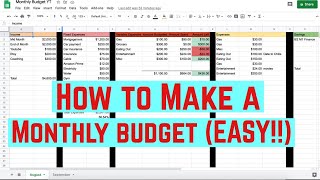
You will build a simple monthly budget in a spreadsheet that splits your pay across bills, debt, savings and personal spending. It suits anyone who wants one clear view of where the money goes each month. You only need your take-home pay and a list of your regular costs.
YouTube video: How I Budget My £3,000 Salary | October 2026 Budget Tutorial
Caption availability is unknown. Check the CC control in the YouTube player.
- Video length
- 32 min 35 s
- Time to do it
- 30 minutes
- Difficulty
- Easy
- Steps
- 9
What you need
Steps
Open a blank spreadsheet in Google Sheets or Excel. Add four column headers across the top: Category, Planned, Actual and Difference.
Type your take-home pay for the month into a cell at the top. Use the amount that actually lands in your bank account after tax.
List every fixed cost on its own row: rent or mortgage, council tax, insurance, phone, subscriptions and travel.
Add debt payments and bills as separate rows, and write the due date beside each one so nothing slips past.
Set aside a savings or investing amount before you plan any spending. Even a small fixed amount counts.
Give each remaining category a planned figure, including food, fuel and personal spending. Round each bill up slightly.
Add a SUM formula at the bottom of the Planned column. Compare the total with your income and trim or move amounts until the two match.
During the month, enter what you really spend in the Actual column and use a subtraction formula to show the difference.
At month end, review the differences and adjust next month's planned figures so they match your real spending.
Tips and common mistakes
Round every bill up to the nearest pound so a small price rise does not break the plan.
Keep a small buffer row for one-off costs like car repairs or birthday gifts.
Update the Actual column once a week, because rebuilding a month of receipts later is slow.
Do not store account numbers or card details in a spreadsheet you share or sync widely.
Questions
Should I build my own spreadsheet or use a template?
A template is faster, but typing your own rows forces you to decide what matters. Start from a template and edit the categories to fit your life.
How much should I put into savings each month?
Pick an amount you can keep to every month, even if it is small, and treat it like a bill. Raise it once your fixed costs are covered.
What if my income changes each month?
Budget from your lowest expected month so the basics are always covered. When a better month arrives, move the extra into savings.
The notes are drafted automatically from video details and general task knowledge. How the guide was prepared
Report a correction