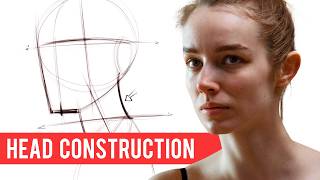
My Secret Trick to Draw Accurate Proportions, by Florent Farges - arts on YouTube. 17 min 36 s.
- Video length
- 17 min 36 s
- Time to do it
- 30 minutes
- Difficulty
- Medium
- Steps
- 10
What you need
Steps
Tape your reference photo upright next to your paper at the same eye level. You should be able to look from one to the other without turning your head.
Block in the overall shape of the head with the 2H pencil. Use straight, light lines and stop before you draw any features.
Mark the landmarks first: top of the skull, chin, eye line, base of the nose and mouth line. Place them as simple dots or short dashes.
Measure with your pencil. Hold it at arm's length toward the photo, set your thumb on the distance you want, then compare that distance to your drawing.
Compare width to height. Most beginners make the head too narrow, so check the widest point of the skull against the chin-to-crown distance.
Find the halfway line of the head. On a real skull the eyes sit close to the middle, not high up near the forehead.
Check the tilt of each feature by lining your pencil up with it on the photo, then holding the same angle over your drawing.
Step back two or three paces every few minutes. Errors in proportion are much easier to see from a distance than up close.
Hold the drawing up to your small mirror and look at the reflection. Reversed, the drawing shows every tilt and lopsided distance you stopped noticing.
Fix what the mirror shows with the kneaded eraser, then firm up the lines with HB and add darker values with 2B once the proportions sit right.
Tips and common mistakes
Keep your lines light with the 2H until the proportions are settled, because dark graphite is hard to lift cleanly.
Compare distances between features rather than staring at one eye or nose on its own.
If you have no mirror, flip the drawing upside down or photograph it and mirror the image on your phone.
Draw the shapes you actually see, not the symbol your brain expects for an eye or a mouth.
Questions
How long should the blocking-in stage take?
Give it most of your drawing time. Fixing a wrong chin or eye line after you have shaded is far slower than moving a light pencil mark.
Why does my face still look wrong when the measurements match?
Proportion is only part of it. Check the shapes between features, the values and the edges, and compare your drawing to the photo in a mirror again.
Should I practise from photos or from life?
Both help. Photos stay still while you learn to measure, and drawing a real person teaches you to judge depth and light.
This guide was drafted from the video's details and general task knowledge. It has not been checked against the full video. Check the video and relevant product instructions before following a procedure. Report a correction.