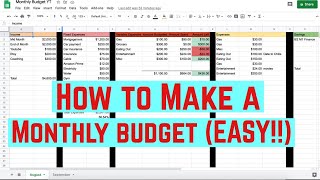
Set up a simple spreadsheet budget that splits your income into needs, wants and savings using the 50/30/20 rule. It suits beginners who feel money disappears each month and want one clear place to track income, spending and recurring payments. You only need a spreadsheet app and your recent bank statements.
YouTube video: Ultimate Annual Budget Tutorial - Debt Tracker - Recurring Transactions - Track your payments
Caption availability is unknown. Check the CC control in the YouTube player.
- Video length
- 36 min 24 s
- Time to do it
- 45 minutes
- Difficulty
- Easy
- Steps
- 9
What you need
Steps
Open a new spreadsheet and add four column headers in row 1: Date, Description, Category and Amount. Add a fifth column called Type for needs, wants or savings.
List your monthly take-home income in a separate cell block below the table. Use the amount that actually lands in your account after tax, not your gross salary.
Calculate your three targets. Multiply net income by 0.5 for needs, 0.3 for wants and 0.2 for savings. Put each result in its own labelled cell.
Go through your last two months of statements and enter every transaction into the table. Assign each one a category and a type of needs, wants or savings.
Add a summary area that sums the Amount column by type. Use SUMIF so each total updates automatically as you add rows.
Compare each total to its target. If needs are over 50 percent, look for bills to cut. If wants are over 30 percent, trim the smallest repeat spends first.
Create a recurring transactions list for fixed costs like rent, phone and subscriptions. Add the due date and amount so you can tick each one off when it is paid.
Add a debt tracker block with columns for creditor, balance, interest rate and minimum payment. Update the balance each month as you pay it down.
At the start of each month, copy the sheet, clear the transactions and keep the formulas. Plan the month by entering known bills before you spend.
Tips and common mistakes
Round your income down and your bills up so the budget has a small buffer.
Log spending weekly rather than monthly so nothing gets forgotten.
Treat savings as a fixed bill you pay first, not what is left over.
Check subscriptions every few months and cancel any you no longer use.
Questions
What counts as a need versus a want?
Needs are rent, groceries, utilities, insurance and minimum debt payments. Wants are dining out, streaming and hobbies. Savings covers emergency funds and extra debt payments.
Do I need a paid budgeting app?
No. A basic spreadsheet with SUMIF formulas does the job. A paid app mainly saves time on importing transactions.
What if my needs are already over 50 percent?
Focus on cutting wants first, then look at fixed costs like phone plans or insurance. Adjust the percentages to fit your real situation rather than forcing the rule.
The notes are drafted automatically from video details and general task knowledge. How the guide was prepared
Report a correction