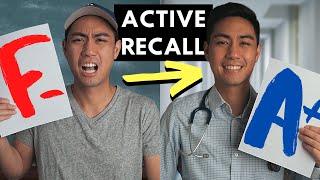
Active recall means testing yourself instead of rereading notes. You will learn a simple loop of question, answer and check that works for nursing lectures and NCLEX-style practice. It suits nursing students with lecture notes, slides and a set of practice questions ready.
YouTube video: Active recall for nursing students,how to study for NCLEX,best study method for nursing school,how
Caption availability is unknown. Check the CC control in the YouTube player.
- Video length
- 2 min 14 s
- Time to do it
- 30 minutes per session
- Difficulty
- Easy
- Steps
- 8
What you need
Steps
Close your notes and write down everything you remember from the lecture or reading. Do this first, before you look at anything.
Open your notes and mark what you missed or got wrong. Those gaps are what you study next, not the parts you already knew.
Turn each main idea into a question on a flashcard, such as what drug class treats this condition or what are the signs of this imbalance.
Answer each card out loud or in writing without looking. Say the full answer, then flip the card to check.
Sort your cards into two piles, ones you knew and ones you missed. Run the missed pile again until every card is in the known pile.
Work through NCLEX-style practice questions on the same topic. Read the rationale for each answer, right or wrong, and note the reason.
Write a short list of the facts you keep missing. Review that list at the start of your next session before adding new material.
Repeat the question and check loop on days 1, 3 and 7 after the lecture. Short repeated sessions beat one long reread.
Tips and common mistakes
Rereading and highlighting feel productive but do not test your memory, so keep them short.
Answer before you check, even when you are unsure, because the effort is what builds recall.
Study in 25 minute blocks with a 5 minute break to keep your answers sharp.
Say your answers out loud when you can, since explaining a concept shows gaps that silent reading hides.
Questions
How is active recall different from just rereading my notes?
Rereading feels familiar but does not prove you know the material. Active recall makes you pull the answer from memory first, then check it, which shows you what you actually need to restudy.
How often should I do this for each lecture?
Once within a day of the lecture, then again after two or three days, then about a week later. Three short sessions beat one long cram before an exam.
Do flashcards count as active recall?
Yes, if you try to answer before flipping the card. Reading both sides of a card without guessing first turns it back into passive review.
The notes are drafted automatically from video details and general task knowledge. How the guide was prepared
Report a correction