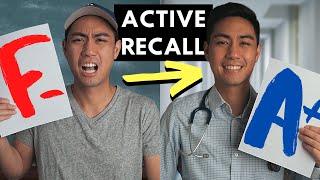
You will build a study routine that uses three methods together: active recall, spaced repetition and the Feynman technique. It suits students revising for exams or anyone learning a new skill. All you need is your notes, paper and a little daily time.
YouTube video: How to Learn 10X Faster it Feels ILLEGAL
Caption availability is unknown. Check the CC control in the YouTube player.
Choose a chapter (8)
- Video length
- 4 min 20 s
- Time to do it
- 20 minutes a day
- Difficulty
- Easy
- Steps
- 9
What you need
Steps
Choose one topic you need to learn and put your notes and textbook in front of you. Close every tab and app that is not part of the subject.
Stop the common mistake of rereading and highlighting. It feels productive but leaves little memory behind. Study by testing yourself instead.
Take a blank sheet and write down everything you remember about the topic without looking. Then open your notes and mark what you missed.
Turn each heading in your notes into a question. Answer it out loud or in writing before you check the source.
Move your questions into flashcards. Review them one day later, then three days, one week and two weeks after that.
Keep each review session short. Ten to fifteen minutes of honest recall beats an hour of passive reading.
Explain the topic in plain words as if teaching a beginner. Write the explanation out or say it aloud without notes.
Notice where your explanation gets vague or jumps a step. Go back to the source, relearn that part and simplify it again.
Run all three together each week: recall first, then a spaced flashcard review, then a short written explanation.
Tips and common mistakes
Do your hardest recall early in the day when your focus is best.
Keep flashcard answers to a single fact so each card is quick to test.
If an explanation still needs jargon, you have found a gap worth relearning.
Schedule reviews in your calendar so you do not skip them when you feel busy.
Questions
How long should each study session be?
Around 20 to 30 minutes of active work is enough for one topic. Take a short break before starting the next subject.
Can I use this method for a practical skill, not just exams?
Yes. Test yourself by doing the task without help, space your practice across days and explain the steps to someone else.
Do I need an app?
No. Paper flashcards and a written review schedule work fine. An app like Anki just handles the timing for you.
The notes are drafted automatically from video details and general task knowledge. How the guide was prepared
Report a correction