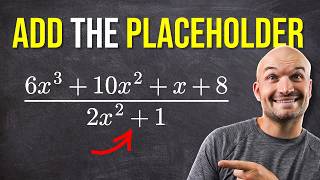
How To Solve Quadratic Equations By Factoring, by Drinking Math on YouTube. 6 min.
- Video length
- 6 min
- Time to do it
- 10 minutes
- Difficulty
- Easy
- Steps
- 8
What you need
Steps
Write the equation in standard form, ax^2 + bx + c = 0. Move every term to one side so the other side is exactly zero.
Note your values. In x^2 + 5x + 6 = 0, a is 1, b is 5 and c is 6. You need two numbers that multiply to c and add to b.
List the factor pairs of 6: 1 and 6, then 2 and 3. Add each pair: 1 + 6 = 7, but 2 + 3 = 5, so 2 and 3 are the ones you want.
Write the factored form as (x + 2)(x + 3) = 0. Both signs are positive here because b and c are both positive.
Apply the zero product property. If two things multiply to zero, at least one of them is zero, so x + 2 = 0 or x + 3 = 0.
Solve each small equation. x + 2 = 0 gives x = -2, and x + 3 = 0 gives x = -3. These are your two roots.
Check both answers by substituting back. For x = -2: 4 - 10 + 6 = 0. For x = -3: 9 - 15 + 6 = 0. Both work.
Adjust for negative signs. For x^2 - 5x + 6 = 0 the pair is -2 and -3, since they multiply to 6 and add to -5, giving (x - 2)(x - 3) = 0.
Tips and common mistakes
Always get zero alone on one side before you factor, or the number pair will be wrong.
If no whole-number pair multiplies to c and adds to b, the quadratic may not factor neatly, so switch to the quadratic formula.
When a is not 1, take out the greatest common factor first, then factor what is left.
Write both roots, since a quadratic almost always has two solutions.
Questions
What is the zero product property?
It says that if two factors multiply to zero, at least one factor must equal zero. That is why you set each bracket to zero separately.
How do I pick the right number pair?
List every pair that multiplies to c, then add them. The pair whose sum equals b is the correct one.
Can I factor when the equation has a minus sign in the middle?
Yes. Use two negative numbers when c is positive, or one of each sign when c is negative, then check that the sum matches b.
This guide was drafted from the video's details and general task knowledge. It has not been checked against the full video. Check the video and relevant product instructions before following a procedure. Report a correction.