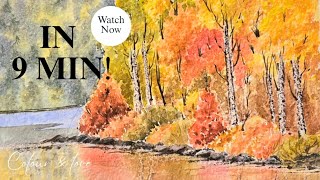
How to Paint More Interesting Green with Watercolor, by The Mind of Watercolor on YouTube. 9 min 6 s.
- Video length
- 9 min 6 s
- Time to do it
- 30 minutes
- Difficulty
- Easy
- Steps
- 7
What you need
Steps
Tape a sheet of cold-pressed watercolor paper to a board, or work on a watercolor block. Keep it flat so washes pool evenly instead of running off.
Squeeze out a warm yellow, a cool yellow, a warm blue and a cool blue into separate palette wells. Leave ready-made green tubes closed for now.
Mix each yellow with each blue in its own well. You get four different greens, from bright spring green to dull olive, without buying anything extra.
Paint a small swatch of every mix on scrap paper and let it dry. Watercolor greens dry lighter and duller than they look when wet.
Add a little red or burnt sienna to part of a green to mute it. Save these quieter greens for shaded foliage and distant trees.
Paint foliage in layers. Lay a light yellow-green wash first, then drop a cooler blue-green into it while it is still damp for depth.
Vary the greens across one tree. Use warm yellow-green where the light hits, cool blue-green in the shade, and a darker muted green at the base.
Tips and common mistakes
Mix more paint than you think you need, because a half-dry mix gives streaky, patchy foliage.
Stop stirring once the paint is combined, since overworking a mix dulls the green and pushes it toward mud.
Darken greens with a deeper blue or a touch of purple rather than black, which kills the color.
Rinse your brush between mixes so leftover paint does not quietly turn every green the same shade.
Questions
Why do my watercolor greens look flat?
You are probably using one green at a single strength. Mix several greens and vary light, middle and dark values so foliage has depth.
Do I need tube greens like sap green or Hooker's green?
No. Blues and yellows give you a wider range, and you can still add a tube green to a mix for a shortcut.
How do I stop greens from turning muddy?
Keep your water clean, use no more than two or three pigments in one mix, and let each layer dry before adding the next.
This guide was drafted from the video's details and general task knowledge. It has not been checked against the full video. Check the video and relevant product instructions before following a procedure. Report a correction.