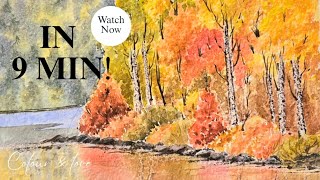
How to Paint Autumn Foliage & Water Reflections in Watercolour (Beginner Friendly) RAJU MORE I, by Raju More on YouTube. 26 min 47 s.
- Video length
- 26 min 47 s
- Time to do it
- 45 minutes
- Difficulty
- Easy
- Steps
- 9
What you need
Steps
Tape your paper to a board or table so it stays flat. Sketch a light horizon line about two thirds down the page for the far shore.
Mix warm autumn colours on your palette. Blend yellow with a little red for orange, and red with a touch of brown for deep rust.
Paint the sky first with clean water, then drop in pale blue or warm grey. Keep it light and let it dry before moving on.
Paint the distant tree line with soft, wet dabs of orange, yellow and brown. Leave gaps so the sky shows through the leaves.
Add the larger trees in front with stronger colour and small brush strokes. Vary the shapes so they do not look like one solid block.
Paint the lake with a light wash of blue-grey. While it is still wet, pull short vertical strokes of tree colour down into the water for reflections.
Add soft horizontal ripples across the water with a clean damp brush. Keep the lines broken and uneven, not straight.
Paint a few ducks as small dark shapes with a lighter head. Place them where the reflection is calm so they stand out.
Let the painting dry fully, then add darker accents to trunks and foreground edges. Lift any mistakes with a damp brush and blot with paper towel.
Tips and common mistakes
Test each mixed colour on scrap paper before putting it on the painting, since watercolour dries lighter than it looks wet.
Keep reflections directly below their trees and slightly wobbly so the water looks real.
Work from light to dark and let each layer dry, or the colours will turn muddy.
Do not overwork wet areas; a few confident strokes look better than many small ones.
Questions
Do I need special watercolour paper?
Yes, use watercolour paper rather than printer paper. It holds water without buckling and lets you lift colour if you make a mistake.
How do I stop the colours turning muddy?
Let each layer dry before adding the next, and rinse your brush between colours. Mixing too many colours while wet is the usual cause of mud.
Can I paint this with only a few colours?
You can get close with yellow, red, brown and blue. Mix orange from yellow and red, and use blue for the sky and water.
This guide was drafted from the video's details and general task knowledge. It has not been checked against the full video. Check the video and relevant product instructions before following a procedure. Report a correction.