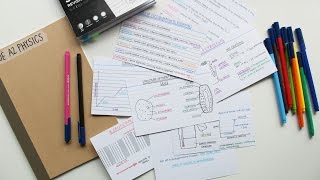
This guide shows you how to revise so facts actually stick, using active recall, spaced repetition and ready-made flashcards. It suits GCSE and A-level students who have notes but forget them in the exam. You will need your exam specification and a set of pre-made flashcards.
YouTube video: The Ultimate Guide to Memorisation (Get A*s/9s)
Caption availability is unknown. Check the CC control in the YouTube player.
Choose a chapter (10)
- Video length
- 14 min 23 s
- Time to do it
- 1 hour to set up
- Difficulty
- Easy
- Steps
- 8
What you need
Steps
Download or print the specification for each subject. Go through it and tick every point the exam board says you must know. Work from that list, not from the whole textbook.
Turn each ticked point into a question you can test yourself on, such as 'What is the equation for photosynthesis?' or 'Name three causes of the Weimar hyperinflation'.
Cover the answer and say or write it from memory before you check. This is active recall. Reading notes again feels easier but does far less for your memory.
Use pre-made flashcard decks instead of writing your own. Making cards feels productive but eats revision time, and good decks for GCSE subjects already exist.
Set a review schedule for each deck: same day, then three days later, then a week, then two weeks. Short repeated reviews beat one long session.
Change your method to suit the subject. Use flashcards for definitions and processes, quote banks for English, and timed past paper questions for maths.
Mark every recall attempt honestly. Anything you got wrong or half-right goes back into the next review round, not into a 'done' pile.
Finish each topic with a past paper question under timed conditions. This tests recall and exam technique at the same time.
Tips and common mistakes
Say answers out loud or write them down, because silently thinking you know something is easy to fake.
Keep sessions to around 25 minutes with a short break, since recall gets sloppy when you are tired.
Do not test yourself on material you have never learned. Read the topic once first, then start recalling.
Review old decks weekly so topics from September are still fresh in June.
Questions
Should I make my own flashcards?
It is usually a waste of revision time. Buy or download a good pre-made deck for your exam board and spend the saved hours actually testing yourself.
How often should I review a flashcard deck?
Review it the same day you learn it, then three days later, then after a week and after two weeks. Cards you get wrong come back sooner.
Does this work for essay subjects like English or History?
Yes, but use quote banks, dates and essay plans as your cards rather than single-word definitions. Then practise full essay paragraphs from memory.
The notes are drafted automatically from video details and general task knowledge. How the guide was prepared
Report a correction