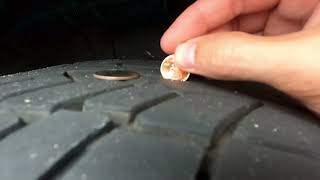
How To Measure Tread Depth With a Tire Gauge, by Your Home Garage on YouTube. 5 min 39 s.
- Video length
- 5 min 39 s
- Time to do it
- 10 minutes
- Difficulty
- Easy
- Steps
- 8
What you need
Steps
Park on level ground, switch off the engine and set the parking brake. Measure with the tires cold so your readings stay consistent from month to month.
Find the wide grooves that run around the tire, not the thin slits cut across the tread blocks. You will measure inside those main grooves.
Push the gauge probe into a groove and press the flat foot of the tool firmly against the tread surface. Keep the probe straight, not tilted.
Slide the barrel down until the probe touches the bottom of the groove, then lift the gauge out without moving the barrel.
Read the number where the barrel edge meets the scale. Most gauges show 32nds of an inch on one side and millimetres on the other.
Reset the gauge by pushing the probe back into the body, then repeat in the inner, centre and outer groove at three points around the tire.
Write down the lowest number for each tire. On most cars, 2/32 inch (1.6 mm) is the legal minimum, and 4/32 inch is a sensible point to start shopping for new tires.
Compare the readings across all four tires. A big difference between the inner and outer edge of one tire points to alignment or inflation problems worth checking.
Tips and common mistakes
Never measure on top of a wear indicator bar, since that gives you a false low reading.
Check your tread once a month and before long trips, so you spot wear before it becomes urgent.
The coin test only tells you yes or no, so use the gauge when you need an actual number.
Questions
What tread depth means my tires need replacing?
Most places set 2/32 inch (1.6 mm) as the legal minimum. Many tire makers suggest replacing nearer 4/32 inch because wet grip drops off well before the legal limit.
Why do I get different numbers around the same tire?
Wear is rarely even. Measuring in several grooves and at several points around the tire shows the lowest spot, which is the number that matters for safety.
Does a cheap manual gauge work as well as a digital one?
A simple sliding gauge is accurate enough for home checks as long as you keep it straight and press the foot flat. Digital gauges are easier to read but not required.
This guide was drafted from the video's details and general task knowledge. It has not been checked against the full video. Check the video and relevant product instructions before following a procedure. Report a correction.