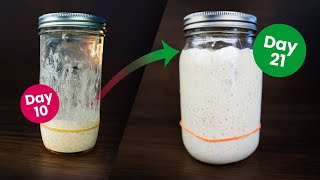
You will mix flour and water and let wild yeast grow over several days until the starter bubbles and doubles. It suits total beginners who want to bake crusty sourdough bread at home. You only need flour, water, a jar and a digital scale.
YouTube video: My Easy GUIDE To Making A SOURDOUGH STARTER | How To Make A Sourdough Starter from scratch
YouTube’s video details do not confirm captions. Check CC in the player for available tracks.
Other videos for this task
- How to make a sourdough starter from scratch 8:56 · 8 written steps
- How to make a sourdough starter from scratch 32:39 · 8 written steps
- How to make a sourdough starter from scratch 6:55 · 8 written steps
- How to make a sourdough starter from scratch 1:04 · 7 written steps
- How to make a sourdough starter from scratch 8:00 · 7 written steps
- How to make a sourdough starter from scratch 29:15 · 7 written steps
- How to make a sourdough starter from scratch 24:31 · 7 written steps
- How to make a sourdough starter from scratch 59:15 · 7 written steps
- How to make a sourdough starter from scratch 9:39 · 7 written steps
- How to make a sourdough starter from scratch 11:27 · 7 written steps
- How to make a sourdough starter from scratch 1:11 · 7 written steps
- How to make a sourdough starter from scratch 13:55 · 7 written steps
- How to make a sourdough starter from scratch 3:01 · 7 written steps
- How to make a sourdough starter from scratch 18:05 · 6 written steps
- How to make a sourdough starter from scratch 14:42 · 6 written steps
- How to make a sourdough starter from scratch 7:19 · 6 written steps
- How to make a sourdough starter from scratch 12:39 · 6 written steps
- Video length
- 16 min 16 s
- Time to do it
- 7 days
- Difficulty
- Easy
- Steps
- 7
What you need
Steps
Weigh 50 g whole wheat or rye flour and 50 g water into a clean jar. Stir until no dry flour remains.
Loosely cover the jar with its lid so gas can escape. Leave it at room temperature, around 21 to 24 C.
After 24 hours, check for small bubbles. If you see none, wait another day before feeding.
Discard half the starter, then add 50 g unbleached white flour and 50 g water. Stir well.
Repeat this discard and feed once a day, keeping the jar loosely covered.
Around day 4 to 7 the starter should double in size a few hours after feeding and smell pleasantly sour.
Feed it once or twice a day at room temperature, or store it in the fridge and feed weekly.
Tips and common mistakes
Use filtered or non-chlorinated water, since chlorine can slow yeast growth.
Keep the jar away from cold drafts and direct sun.
A dark liquid on top is normal; stir it in or pour it off before feeding.
Questions
How do I know the starter is ready to bake with?
It doubles in size within 4 to 8 hours of a feed, looks bubbly and smells sour and yeasty. A float test in water can help confirm it.
Can I use all-purpose flour only?
Yes, but whole wheat or rye flour at the start feeds more wild yeast and gets the starter going faster.
What if mold appears?
Throw the starter away and start fresh in a clean jar. Fuzzy patches are mold, not the normal dark liquid.
The notes are drafted automatically from video details and general task knowledge. How the guide was prepared
Report a correction