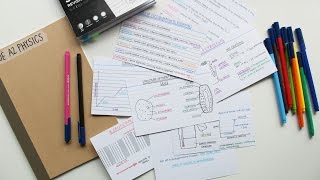
A mind map puts one topic in the centre of the page and spreads related ideas out on branches. You will build a map that shows how concepts connect, which makes revision and recall easier. It suits students of any subject and needs only paper and pens.
YouTube video: The Ultimate Mind Map Tutorial (How To Take Notes)
Caption availability is unknown. Check the CC control in the YouTube player.
- Video length
- 11 min 58 s
- Time to do it
- 20 minutes
- Difficulty
- Easy
- Steps
- 8
What you need
Steps
Turn a blank sheet of paper landscape and write your main topic in the centre. Keep it to a short phrase or a small sketch, not a full sentence.
Draw a thick curved branch out from the centre for each main idea. Aim for five to seven branches so the page stays readable.
Write one keyword on each branch, printed in capitals and sitting on the line. Drop the sentences and keep only the idea.
Add thinner lines off each branch for supporting details, definitions and examples. Put the most important points closest to the centre.
Give each topic family its own colour. That way you can spot groups of related ideas at a glance when you revise.
Link related branches with arrows, symbols or simple drawings. These links are the whole point, so mark them clearly.
Leave space between branches. As you review your notes, add new words and links rather than squeezing them in.
Close your book and redraw the map from memory on a fresh page. Then check your notes and fill in what you missed.
Tips and common mistakes
Copying sentences straight from a book fills the page but does not test your understanding.
Redrawing the map from memory is the step that does the learning, so do not skip it.
Keep one topic per page. Two maps beat one crowded map.
If a branch grows too big, move it to its own page and link back to the main map.
Questions
How many branches should a mind map have?
Start with five to seven main branches. More than that gets hard to read, and you can always split a big branch onto a second page.
Can I make a mind map on a tablet?
Yes. Apps such as GoodNotes or XMind work well, and you can move branches around. Paper is faster to start and easier to redraw from memory.
Does mind mapping work for every subject?
It suits topics with linked ideas, like biology, history or business. For formulas and calculations, pair the map with practice questions.
The notes are drafted automatically from video details and general task knowledge. How the guide was prepared
Report a correction