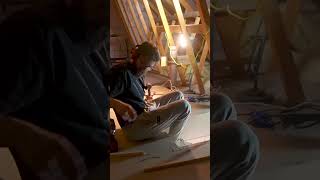
A warm loft puts insulation between and under the rafters instead of on the floor, so the roof space stays usable and the rooms below keep their heat. This suits confident DIYers who can measure, cut rigid foam boards and fix timber battens. You will need safe ladder access and a clear plan for ventilation before you start.
YouTube video: PART 1 How to Insulate a Warm Loft | DIY Loft Insulation & Framing Tips
Caption availability is unknown. Check the CC control in the YouTube player.
- Video length
- 1 min 2 s
- Time to do it
- 2 days
- Difficulty
- Medium
- Steps
- 8
What you need
Steps
Measure the depth of each rafter and the spacing between centres, usually 400 mm or 600 mm. Write the figures down so you can order boards in the right thickness.
Check for a clear air path above the insulation. Leave a 50 mm ventilation gap running from the eaves to the ridge so the roof can breathe.
Cut the PIR boards about 10 mm wider than each rafter bay. Push them in so they stay put by friction, with the foil face pointing into the room.
Seal every joint and edge with foil tape, and fill wider gaps with expanding foam. Any cold bridge here cancels out the work you just did.
Screw timber battens across the rafters to make a service void. This gives you somewhere to run cables and fix plasterboard later.
Add a second layer of thinner insulation under the battens if you need a better U-value. Keep it tight against the first layer with no air pockets.
Clip cables to the face of the battens rather than burying them in insulation. Cables that cannot shed heat can overheat.
Fix plasterboard across the battens and skim or tape the joints. Work from a stable platform, never from the rafters alone.
Tips and common mistakes
Wear a dust mask, goggles and gloves when cutting PIR boards, as the fibres and dust irritate skin and lungs.
Never squash insulation into a thin gap to make it fit, because compressed boards lose most of their insulating value.
Do not block the eaves ventilation with boards or offcuts, or condensation will build up in the roof.
Take boards up in small batches and keep the loft hatch clear so you always have a safe way out.
Questions
Do I need a vapour barrier under the boards?
With foil-faced PIR boards and taped joints, the foil usually acts as the vapour control layer. Check the board manufacturer's guidance for your roof build-up before adding a separate sheet.
Can I put insulation straight over old mineral wool?
Not in a warm loft. Remove loose or damp wool first so the rigid boards sit tight against the rafters and you can see any gaps.
What if my rafters are too shallow for a 50 mm gap?
Use thinner boards or add counter battens under the rafters to gain depth. Losing the ventilation gap risks rot in the roof structure.
The notes are drafted automatically from video details and general task knowledge. How the guide was prepared
Report a correction