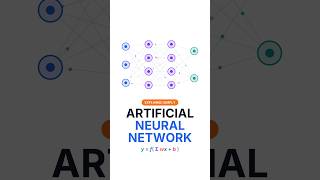
You will learn how to walk a beginner through a single feed forward pass, the step where a neural network turns input numbers into a prediction. It suits students meeting AI, machine learning or deep learning for the first time. All you need is a pen, paper and one small worked example.
YouTube video: Neural Networks Made Easy: Feed Forward Explained
YouTube’s video details do not confirm captions. Check CC in the player for available tracks.
- Video length
- 1 min 58 s
- Time to do it
- 15 minutes
- Difficulty
- Easy
- Steps
- 9
What you need
Steps
Start with the big picture. A neural network is a chain of layers that turns input numbers into a prediction. Compare it to a factory line where each station passes its work to the next.
Draw three columns of circles and label them input, hidden and output. Connect every circle to every circle in the next column so the beginner can see where numbers travel.
Explain the input layer. Each circle holds one number from your data, like a pixel brightness or the size of a house. No maths happens here, the layer just holds values.
Take one hidden circle and show the maths. Multiply each input by its weight, add a bias, sum the results, then apply an activation function such as ReLU, which keeps positive values and sets negatives to zero.
Repeat that calculation for every hidden circle, using a different set of weights each time. Point out that the weights are what the network learns later.
Stress the name. Feed forward means data moves one way only, left to right, with no loops or going back. That single direction is what makes the pass simple.
Explain the output layer. It turns the last hidden values into the final answer, a probability between 0 and 1 for classification or a plain number for regression.
Walk through one full pass with real numbers on paper. Use two inputs, two hidden circles and one output so the arithmetic stays small enough to follow.
Close by saying that feed forward only makes the prediction. Backpropagation comes afterwards to adjust the weights when the prediction is wrong.
Tips and common mistakes
Keep the same example through every step so the beginner is not relearning the data each time.
Use small round numbers like 0.5 and 0.3 so the mental arithmetic does not hide the concept.
Skip words like tensor, gradient and epoch until the forward pass is clear.
Ask them to calculate one hidden circle alone before you show the whole pass.
Questions
What is the difference between feed forward and backpropagation?
Feed forward is the forward pass that produces a prediction from the inputs. Backpropagation runs afterwards and works out how to change the weights so the next prediction is better.
Does a beginner need calculus to understand this?
No. Feed forward needs only multiplication, addition and one simple activation rule. The calculus belongs to the training step, not to the forward pass.
How many hidden layers should I show?
One is enough for a first explanation. Mention that real networks stack many hidden layers, which is what the term deep learning refers to.
The notes are drafted automatically from video details and general task knowledge. How the guide was prepared
Report a correction