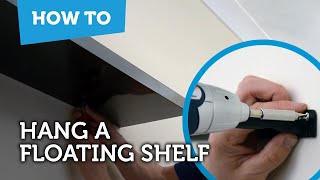
You will build a box frame from metal drywall channel and stud, fix it to the wall with proper hollow-wall plugs, then clad it in plasterboard to make a strong floating shelf. It suits anyone with basic drill and cutting skills. A laser or spirit level and the right anchors are the key requirements.
YouTube video: ✅ Floating Shelf 🦾 How to make strong plasterboard shelf 👉 drywall
Caption availability is unknown. Check the CC control in the YouTube player.
- Video length
- 4 min 57 s
- Time to do it
- 2 to 3 hours
- Difficulty
- Medium
- Steps
- 10
What you need
Steps
Mark the height of the shelf on the wall with a laser line or a long spirit level. Check the line twice before you drill anything, because everything else follows it.
Cut a piece of metal channel about 120 cm long for a shelf around 73 cm by 27 cm. Measure 25 cm in from each end and mark both spots.
Cut slots in the flanges at your marks so you can bend the ends of the channel forward. These bent ends become the two sides of the shelf frame.
Hold the channel on your line and drill one hole in the middle to pin it in place. Then drill through the channel at both outer edges, where the fixings carry the most load.
Screw the channel to the wall through those edge holes using good hollow-wall plugs. Push each plug in until the rim sits flush so it cannot slip through the hole.
Cut short pieces of metal stud to fit between the wall channel and the front of the frame. Fix them in the centre as uprights so the shelf cannot sag.
Cut the front channel to length and screw it across the ends of the uprights. Check the front with the level and tap thin wedges behind the wall channel if it needs lifting.
Square up the two sides, check that both are the same length, and screw them to the front channel and the wall channel.
Measure and cut plasterboard panels for the top and underside. Screw them into both the channel and the studs, adding screws where a stud crosses the channel.
Measure the width of the front edge, cut plasterboard strips for the front and sides, screw them on, and trim any overhang with a handsaw. Fill the screw heads and joints afterwards.
Tips and common mistakes
Never rely on plain plastic plugs in bare plasterboard for a shelf that holds weight, use expanding hollow-wall anchors or fix into studs.
Screw through the plasterboard wherever a stud crosses the channel, not just along the edges, as this is what stops the shelf flexing.
Wear gloves and eye protection when cutting metal channel, the cut edges are sharp.
Load the shelf gradually and keep the weight near the wall rather than at the front edge.
Questions
Can a plasterboard shelf hold heavy things?
Yes, if the frame is screwed into the wall with proper hollow-wall anchors at the outer edges and reinforced with uprights. Keep heavy items toward the back of the shelf.
What if there is no stud behind the wall where I want the shelf?
Use expanding metal or heavy-duty hollow-wall anchors rated for the load. The four-way expansion type grips in hollow plasterboard far better than a plain plug.
Do I have to fill and paint the plasterboard?
The frame only needs filling at the screw heads and joints once it is clad. Sand smooth and paint or skim to match the wall.
The notes are drafted automatically from video details and general task knowledge. How the guide was prepared
Report a correction