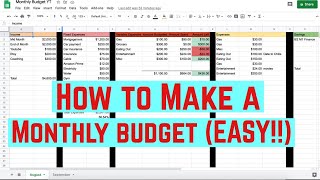
You will set up one spreadsheet tab that covers income, fixed bills, non-monthly costs, variable spending, and savings for a single month. It suits anyone paid a regular salary who wants a repeatable plan instead of guessing. You need last month's bank and card statements plus your pay stub.
YouTube video: budget with me for september!! | DINKs in HCOL city
Caption availability is unknown. Check the CC control in the YouTube player.
Choose a chapter (8)
- Video length
- 14 min 31 s
- Time to do it
- 45 minutes
- Difficulty
- Easy
- Steps
- 8
What you need
Steps
Open a new spreadsheet and name the first column for next month. In the rows beside it, list every income source you expect, using your take-home pay after tax.
Add rows under income for health insurance premiums, HSA contributions, and retirement contributions. Subtract them so you see what is actually left to spend.
Create a fixed expenses block: rent or mortgage, utilities, phone, internet, insurance, loan payments, and subscriptions. Enter the exact amount for each from your statements.
List costs that do not arrive every month, like car repairs, annual fees, gifts, and holidays. Divide each yearly total by 12 and set that amount aside monthly.
Fill in variable spending: groceries, fuel, eating out, and fun. Use your last three months of statements to pick a realistic number for each line rather than a guess.
Add a savings and investing block. Give it a set amount or a percentage of income, and treat it as a bill you pay before discretionary spending.
Total every block and compare the sum to your income. If the total is higher, cut the variable lines first, then adjust savings.
Save the file as a template and duplicate the tab each month, so you only update amounts instead of rebuilding the layout.
Tips and common mistakes
Pull real numbers from statements instead of estimating, or the plan will not survive the month.
Keep non-monthly costs as their own line so a car repair does not wreck your regular budget.
Review the sheet once a week and log actual spending next to the planned amount.
Questions
How many categories should a monthly budget have?
Enough to see where money goes, usually 15 to 25 lines across fixed, variable, and savings. Fewer than that hides leaks, more becomes a chore to update.
Should I budget before or after saving?
Fund savings and investing as a fixed line, the same way you treat rent. Waiting for leftovers usually means nothing gets saved.
What if my income changes every month?
Budget from your lowest recent month and treat anything extra as a bonus you assign later. That keeps the plan workable in a slow month.
The notes are drafted automatically from video details and general task knowledge. How the guide was prepared
Report a correction