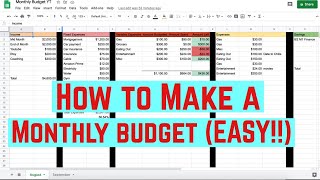
Work out a full month of spending for a large family, from income and fixed bills to groceries, kids' activities and savings. You will set up sinking funds so irregular costs stop catching you out. It suits anyone running a household budget on a set monthly income. You need last month's bank statements and a spreadsheet or budget app.
YouTube video: Budget With Me (June 2026) | Real Monthly Budget for a Family of 7
Caption availability is unknown. Check the CC control in the YouTube player.
Choose a chapter (6)
- Video length
- 11 min 11 s
- Time to do it
- 45 minutes
- Difficulty
- Easy
- Steps
- 8
What you need
Steps
Add up your take-home pay for the month from every source: jobs, side work, benefits and child support. Write the total at the top of your budget.
List your fixed bills next: rent or mortgage, utilities, insurance, phone and minimum debt payments. Use last month's bank statement for the real amounts.
Set spending limits for variable categories like groceries, gas, kids' activities, household items and personal money. Check what you actually spent before picking a number.
Take each category away from your income until nothing is left. Move money between categories rather than letting the total go over.
Open a separate sinking fund for each irregular cost: car repairs, birthdays, holidays, school fees and clothing. Give every fund its own name.
Work out each monthly amount by adding up the yearly cost and dividing by 12. Add that figure to your budget as a fixed line.
Add a savings or investing line before you spend on extras, even if it is small. Treat it like a bill you pay yourself.
Check the budget once a week against your bank app. If a category is overspent, move money from a flexible one to cover it.
Tips and common mistakes
Round every bill up to the next dollar so small overages do not break the budget.
Do not forget yearly costs like car registration or insurance renewals; put them in a sinking fund.
Leave a small buffer for surprises so one unplanned purchase does not sink the month.
Questions
How much should go into sinking funds each month?
Add up what each yearly cost will be, divide by 12, and budget that amount every month. The money sits there until the bill arrives.
What if my income changes every month?
Budget from your lowest expected month and send any extra income to savings or sinking funds. That way a quiet month does not leave you short.
Do I need a spreadsheet?
No, paper or a budgeting app works fine. A spreadsheet just makes the maths and the weekly tracking quicker.
The notes are drafted automatically from video details and general task knowledge. How the guide was prepared
Report a correction