How to write a LAB REPORT for CSEC, CAPE, IB, GCSE, by gSquared Academy on YouTube. 21 min 21 s.
- Video length
- 21 min 21 s
- Time to do it
- 1 hour
- Difficulty
- Medium
- Steps
- 9
What you need
Steps
Read the marking rubric and the question first. Note the required headings, word limit and how marks are split between method, data, analysis and conclusion.
Write a clear title and an aim that names the variable you change and the variable you measure. Keep both to one sentence each.
List the apparatus with sizes and quantities, such as a 250 cm3 beaker or a 0.1 g balance. Add a labelled diagram if the rubric asks for one.
Write the method in past tense and passive voice. Include amounts, temperatures, timings and how you controlled each variable so another student could repeat it.
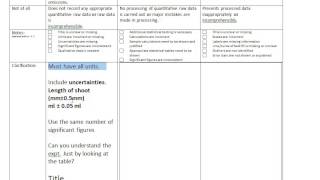
Record results in a ruled table with column headings, units and the correct number of decimal places. Do not round raw readings until you calculate.
Plot a graph with the independent variable on the x-axis and the dependent variable on the y-axis. Label both axes with units and draw a line of best fit.
Describe the trend in words and quote key values. Explain the science behind the result and compare it with the expected value or textbook theory.
State a short conclusion that answers the aim. List two or three sources of error and say how each one affected the result.
Check spelling, units and significant figures, then staple the rubric to the front of the report.
Tips and common mistakes
Write the method as you do the practical, not from memory later.
Keep raw data in a separate notebook and copy it neatly into the report.
Use the same number of significant figures as the measuring instrument allows.
Never change a result to fit the theory. Explain the difference instead.
Questions
How long should a lab report be?
Follow your syllabus or teacher's limit. A school lab report is often 1 to 3 pages, while IB and CAPE write-ups can be longer.
Do I need to include a hypothesis?
Only if your rubric asks. CSEC and GCSE often use an aim, while IB may expect a hypothesis or research question.
What goes in the discussion?
Explain the trend, link it to theory, comment on the size of errors and suggest one improvement.
This guide was drafted from the video's details and general task knowledge. It has not been checked against the full video. Check the video and relevant product instructions before following a procedure. Report a correction.