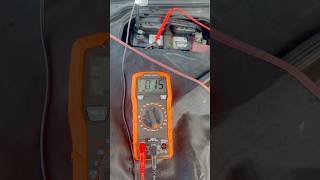
Battery Maintenance: How to Test Voltage, Leaks and More, by AMSOIL INC. on YouTube. 3 min 37 s.
- Video length
- 3 min 37 s
- Time to do it
- 30 minutes
- Difficulty
- Easy
- Steps
- 8
What you need
Steps
Park on level ground, turn off the engine and every accessory, then let the battery sit for about an hour. A rested battery gives you a true reading.
Set your multimeter to DC volts on the 20V range. Touch the red probe to the positive post and the black probe to the negative post.
Read the number. 12.6V or more means fully charged, 12.4V is about half full, and below 12.2V is low and needs charging or further testing.
Start the engine and measure again. A reading of roughly 13.5V to 14.5V shows the alternator is charging, so the battery is likely the problem.
For a leakage test, switch the meter to DC amps, disconnect the negative cable and bridge the gap between post and cable with the probes. Keep doors closed and lights off. A drain above about 50 mA needs tracking down.
Clean any corrosion by mixing baking soda with water and scrubbing the posts and clamps with a brush. Rinse with clean water and dry everything before reconnecting.
On a flooded battery, use a refractometer to check specific gravity. Draw a few drops of electrolyte from each cell and compare the readings. Around 1.265 means fully charged.
Reconnect the positive cable first, then the negative, and tighten the clamps snugly. Coat the posts with terminal protectant to slow new corrosion.
Tips and common mistakes
Wear safety glasses and gloves, since batteries hold acid and give off hydrogen gas that ignites from a spark.
Never lay a tool across both posts at once, and remove the negative cable first and reconnect it last.
Skip the voltage test for an hour after charging, or the surface charge will give a falsely high reading.
Sealed AGM batteries have no cells to open, so do not attempt a specific gravity check on them.
Questions
What voltage should a healthy car battery show?
A fully charged battery at rest reads about 12.6V. Anything under 12.2V is low and should be charged and retested before you blame the battery.
How do I know if it is the battery or the alternator?
Measure the voltage with the engine running. If it climbs to roughly 13.5V to 14.5V, the charging system is working and the battery is the likely culprit.
Why does my battery go flat overnight?
Something is drawing current with the key off. A leakage test with the meter in amps tells you whether the drain is normal or large enough to chase a faulty circuit.
This guide was drafted from the video's details and general task knowledge. It has not been checked against the full video. Check the video and relevant product instructions before following a procedure. Report a correction.