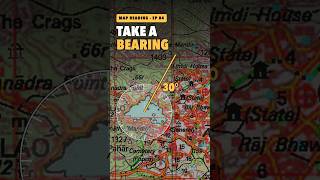
A map bearing lets you walk a straight line to a landmark you can see on the map but not on the ground. This guide suits hikers and backcountry travelers who carry a baseplate compass and a paper map. You only need basic gear and a little practice.
YouTube video: HOW TO USE A MAP AND COMPASS | MKC SURVIVAL GUIDE | SEASON 2 EP 14
YouTube’s video details do not confirm captions. Check CC in the player for available tracks.
Choose a chapter (8)
- Video length
- 6 min 43 s
- Time to do it
- 10 minutes
- Difficulty
- Easy
- Steps
- 6
What you need
Steps
Lay the map flat on the ground or a table. Find your current position and the landmark you want to reach, such as a lake, peak or trail junction.
Place the long edge of the compass baseplate so it runs from your position to the landmark. Keep the direction-of-travel arrow pointing at the landmark.
Turn the compass housing until the orienting lines inside it line up with the north-south grid lines on the map. Check that the orienting arrow points to map north.
Read the number on the housing at the index line. That number is your bearing in degrees. Write it down so you do not forget it.
Lift the compass and hold it flat at chest height. Turn your whole body until the red magnetic needle sits inside the orienting arrow outline.
Look up along the direction-of-travel arrow and pick a distant object on that line. Walk to it, then repeat with a new object until you arrive.
Tips and common mistakes
Keep metal objects, phones and magnets away from the compass, as they pull the needle off north.
Account for local magnetic declination if your map shows it, or your bearing will drift over long distances.
Practice on a short orienteering course before you rely on these skills in the backcountry.
Questions
What map scale should I use?
A 1:24,000 scale map shows enough detail for land navigation on foot. Larger-scale maps cover more ground but hide small features.
Do I need a baseplate compass?
Yes. A baseplate compass with a rotating housing and orienting lines is what makes taking a bearing from a map possible.
What if I cannot see the landmark?
Pick an object along the bearing line that you can see, walk to it, then take a new bearing and repeat.
The notes are drafted automatically from video details and general task knowledge. How the guide was prepared
Report a correction