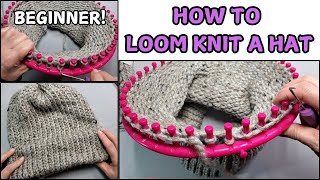
Loom knit hats and flat panels often roll at the edges because knit-only rows make stockinette stitch. This guide shows how to flatten a finished piece with wet or steam blocking, and how to build a border that stops the curl in the first place. It suits beginners working on a round or long loom.
YouTube video: How to remove or prevent curls on the edge #loomknitting projects.
Caption availability is unknown. Check the CC control in the YouTube player.
- Video length
- 1 min 28 s
- Time to do it
- 30 minutes plus drying time
- Difficulty
- Easy
- Steps
- 9
What you need
Steps
Find where the curl happens. A rolling bottom edge on a hat worked only in the knit stitch is normal stockinette curl. An edge that pulls in tight is usually a cast-on or tension problem.
For wool and other natural fibres, fill a basin with cool water and soak the piece for 15 to 20 minutes. Squeeze the water out gently, never wring it.
Roll the damp piece in a towel to press out more water. Pin it flat on a foam mat, stretching the curled edge straight, with pins every 2 to 3 cm.
Leave it to dry for about 24 hours, then remove the pins. The edge should now sit flat and stay flat through normal wear.
For acrylic, pin the dry piece to shape and hold a steam iron 2 to 5 cm above the edge. Let the steam pass through, then leave it to cool fully before unpinning.
To prevent curl, work a border of 4 to 6 pegs on each end in garter stitch, alternating a knit row and a purl row. Garter stitch lies flat and blocks the roll.
On hat brims, knit 1 purl 1 ribbing for 6 to 8 rows before the main pattern. Ribbing pulls in evenly and holds the bottom edge down.
Loosen your tension and try a larger gauge loom or thinner yarn if the fabric feels stiff. Tight, dense fabric curls harder than loose fabric.
Finish with a loose, stretchy bind off, working one peg at a time. A tight bind off puckers the top edge and adds a second curl to fix.
Tips and common mistakes
Test any blocking method on a small swatch first, since too much heat can melt acrylic fibres.
Never rest a hot iron directly on acrylic or polyester yarn, and keep it a few centimetres above the fabric.
Curling is a property of the knit stitch, not a mistake, so plan a flat border before you start the project.
Hand wash a blocked hat in cool water and reshape it while damp so the edge dries flat again.
Questions
Why does my loom knit hat curl at the bottom?
Working only knit rows makes stockinette stitch, which naturally rolls toward the knit side. A garter or ribbed border, or blocking the finished piece, will flatten it.
Can I fix an acrylic hat that already curls?
Yes, light steam blocking usually flattens it. Keep the iron off the fabric and let the piece cool completely before you take the pins out.
Does blocking last after washing?
Mostly, if you hand wash in cool water and reshape the hat while it is damp. Hot water and a machine dryer can pull the curl back.
The notes are drafted automatically from video details and general task knowledge. How the guide was prepared
Report a correction