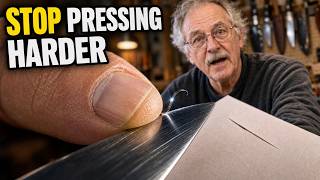
You will learn the basic technique for sharpening a kitchen knife on Japanese water stones, both Japanese and Western blades. It suits home cooks who want a sharp edge without power tools. You need a whetstone, water and a stable surface.
YouTube video: How to Sharpen a Knife with Japanese Whetstones, with Naoto Fujimoto
YouTube’s video details do not confirm captions. Check CC in the player for available tracks.
- Video length
- 21 min 49 s
- Time to do it
- 20 minutes
- Difficulty
- Medium
- Steps
- 9
What you need
Steps
Soak your whetstone in water until bubbles stop rising, usually 10 to 15 minutes for a water stone.
Set the stone on a sink bridge or a damp towel so it cannot slide while you work.
Flatten the stone with a truing stone if it is dished, then rinse it.
Hold the knife with your dominant hand and place the fingers of your other hand flat on the blade near the edge.
Lay the blade at roughly a 15 degree angle for a Japanese knife, or about 20 degrees for a Western knife.
Push the edge across the stone in a smooth stroke, keeping the angle steady, and work the full length of the blade.
Sharpen one side until you feel a burr along the whole edge, then flip the knife and do the same on the other side.
Finish on a finer stone, around 4000 grit, with light strokes to polish the edge.
Rinse the knife, dry it, and test the edge on paper or a tomato.
Tips and common mistakes
Keep the angle constant on every stroke, since a wobbling wrist rounds the edge.
Use light pressure and let the stone do the cutting, not your arm strength.
Keep the stone wet while sharpening and add water when it looks dry.
Do not test sharpness by running your finger along the edge.
Questions
How long should I soak the whetstone?
Soak it until no more bubbles come out, usually 10 to 15 minutes. A fully soaked stone cuts faster and stays cleaner.
What angle should I hold the knife at?
About 15 degrees per side for a Japanese knife and around 20 degrees for a Western knife. Pick one angle and keep it steady.
How often should I sharpen?
Sharpen when the knife stops biting into tomato skin or paper. Between sessions, a few passes on a honing rod keep the edge going.
The notes are drafted automatically from video details and general task knowledge. How the guide was prepared
Report a correction