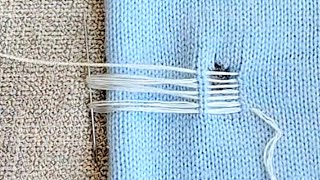
You will hand sew a hem that disappears from the outside, using a catch stitch on thicker fabrics like trousers, skirts and dresses. It suits anyone who can thread a needle and wants a neat finish without a sewing machine. Matching thread to your fabric colour is the key requirement.
YouTube video: How to sew an invisible hem
Caption availability is unknown. Check the CC control in the YouTube player.
- Video length
- 4 min 7 s
- Time to do it
- 30 minutes
- Difficulty
- Easy
- Steps
- 8
What you need
Steps
Try the garment on and pin the new hem length in place. Take it off and trim the excess fabric, leaving about 4 cm (1.5 in) to turn up.
Fold the raw edge under by about 6 mm (1/4 in) and press it. Fold the hem up again to your pinned line and press the fold flat.
Thread a hand needle with a single strand of thread that matches the fabric, then tie a small knot in the end.
Turn the garment inside out. Push the needle up through the folded hem allowance so the knot stays hidden inside the fold.
Take a tiny stitch catching one or two threads of the main fabric, then a small stitch in the hem allowance about 1 cm (0.4 in) to the side.
Repeat that zigzag pattern along the whole hem. Keep the thread slack, so the fabric can still stretch without snapping the stitches.
Finish with two small backstitches inside the hem allowance and trim the thread close to the fabric.
Press the finished hem lightly through a damp cloth to flatten it without leaving a ridge on the outside.
Tips and common mistakes
Do not pull the thread tight after each stitch, or the hem will pucker and show on the outside.
Test the stitch on a scrap of the same fabric first to check your thread colour and stitch length.
Use a single thread, not doubled, so the stitches stay flat and invisible.
Sharp needles and scissors cut cleanly but can slip, so keep your fingers behind the blade and stitch slowly.
Questions
Which fabrics suit a catch stitch hem?
It works best on heavier and thicker fabrics like wool, denim and coat cloth. On thin or slippery fabrics the stitches can show through, so a fine running stitch or a machine blind hem is safer.
How big should the stitches be?
Keep them small, catching only one or two threads of the main fabric. Spacing them about 1 cm apart keeps the hem secure without any of the stitching showing on the outside.
Can I do this on a sewing machine?
Yes, if your machine has a blind hem stitch and a blind hem foot. The hand catch stitch is better for thick fabric and for hems you want to adjust later.
The notes are drafted automatically from video details and general task knowledge. How the guide was prepared
Report a correction