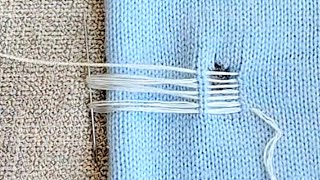
A backstitch is a strong hand stitch for seams and repairs. This guide shows how to work it with your needle moving right to left, the natural direction for left-handed sewers. You need a needle, thread and two small pieces of fabric to practise on.
YouTube video: How to Sew the MOST IMPORTANT Hand Stitch—a Backstitch—as a Lefty🪡 #BeginnerSewing #SewingTutorial
Caption availability is unknown. Check the CC control in the YouTube player.
- Video length
- 1 min 18 s
- Time to do it
- 10 minutes
- Difficulty
- Easy
- Steps
- 8
What you need
Steps
Thread the needle and tie a small knot at the end of the thread. Cut about 18 inches of thread so it does not tangle.
Place two fabric scraps right sides together. Hold them so the raw edge you will sew runs along the top, facing you.
Push the needle up through both layers about 1/8 inch from the edge. Pull the thread through until the knot sits against the fabric.
Move the needle to the right and push it down through both layers about 1/8 inch from your first hole. Pull the thread tight.
Bring the needle back up through the first hole, or just past it to the left. This creates the backward step that gives the stitch its name.
Push the needle down again about 1/8 inch to the right of the new hole. Keep the spacing even as you go.
Repeat the up-and-back motion along the whole seam. Each new stitch should overlap the last one by about half its length.
Finish by taking the needle to the back of the fabric and making two small stitches on top of each other. Trim the thread close to the fabric.
Tips and common mistakes
Keep stitches short, around 1/8 inch, for a seam that holds up to wear and washing.
Do not pull the thread too hard or the fabric will pucker along the seam line.
Left-handed sewers can work right to left without turning the fabric, which keeps the seam straight.
Questions
Is a backstitch stronger than a running stitch?
Yes. The overlapping loops make a backstitch much stronger, so it works well for seams that take strain and for repairs.
Can I use a backstitch on stretchy fabric?
It works, but leave the stitches slightly loose so the seam can stretch without snapping the thread.
What size needle should I use?
A medium hand sewing needle, around size 7 to 9, suits most cotton and linen fabrics. Use a sharper, finer needle for tightly woven cloth.
The notes are drafted automatically from video details and general task knowledge. How the guide was prepared
Report a correction