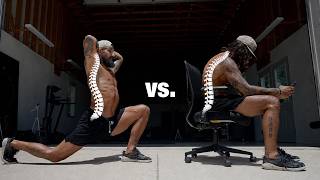
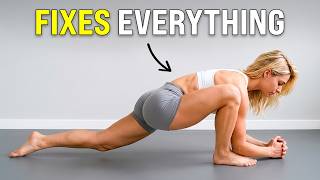
You will learn seated, standing and side-lying stretches plus a strengthening move that target the quadratus lumborum, the deep muscle behind much one-sided lower back pain. It suits anyone with a mild one-sided ache who can move without sharp pain. No equipment is needed.
YouTube video: 30 SECOND FIX: Quadratus Lumborum Pain Relief
Caption availability is unknown. Check the CC control in the YouTube player.
Choose a chapter (6)
- Video length
- 11 min 29 s
- Time to do it
- 10 minutes
- Difficulty
- Easy
- Steps
- 8
What you need
Steps
Sit tall on a chair with your feet flat on the floor. Cross the ankle of the sore side over the other knee, then lean away from the tight hip until you feel a pull along your waist. Hold for 30 seconds.
Come back to center and repeat the seated lean 3 times on the sore side. Breathe out slowly and ease a little deeper on each exhale instead of forcing the stretch.
Stand with feet hip width apart. Reach the arm on the sore side overhead and side bend away from that hip, keeping your hips square and facing forward. Hold for 30 seconds.
Do 3 rounds of the standing stretch, then test the other side. Compare which waist feels tighter so you know which side to work more.
Lie on your side on a bed or mat with the sore side up. Reach the top arm overhead and let the top hip roll back slightly to open the waist. Hold for 30 seconds, then repeat 3 times.
Move to the advanced version once the basic stretches feel easy. Kneel, shift your hips toward the tight side, reach the opposite arm overhead and side bend away. Hold 20 to 30 seconds.
Strengthen the area with a side plank or a standing hip hike on the sore side. Do 3 sets of 20 to 30 seconds, keeping your body in one straight line.
Run through all the moves once and keep the two that give you the most relief. Repeat those two twice a day, morning and evening.
Tips and common mistakes
Stop at once if the pain sharpens, shoots down your leg or brings numbness or weakness, and get it checked by a clinician.
Stretch to a mild pull, not a sharp pain, and never bounce at the end of the range.
A tight muscle is often a weak one, so pair the stretches with the strengthening move for longer lasting relief.
Keep breathing normally through each hold instead of tensing up and holding your breath.
Questions
How fast should I feel a difference?
Some people feel looser after one 30 second hold. Lasting change usually takes a few weeks of doing the moves daily.
Can I do these exercises in bed?
Yes. The side-lying stretch works on a firm mattress, though the floor gives you more control and a truer stretch.
How often should I repeat them?
Twice a day is a good routine. If you feel sore afterwards, drop to once a day and use a gentler range.
The notes are drafted automatically from video details and general task knowledge. How the guide was prepared
Report a correction