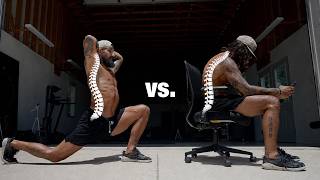
Tight hip flexors often come from your posture system, not just the muscle itself. This guide walks you through simple checks for vision, jaw, shoes and breathing, then shows how to retrain pelvic stability and diaphragmatic breathing. It suits anyone with ongoing hip tightness who has already tried basic stretching.
YouTube video: Why Your Hip Flexors (Psoas) Are Always Tight (It's NOT Your Hip Flexors).
YouTube’s video details do not confirm captions. Check CC in the player for available tracks.
Choose a chapter (7)
- Video length
- 18 min 52 s
- Time to do it
- 20 minutes
- Difficulty
- Medium
- Steps
- 8
What you need
Steps
Stop treating the psoas as an isolated muscle. Think of your hip flexors as part of a whole posture system that keeps you upright and moving forward against gravity.
Stand in front of a mirror and check your posture. Look for a forward head, arched lower back or flared ribs, which signal spinal extension.
Test your vision. Cover one eye, then the other, and note any change in balance, head tilt or how your hips feel.
Check your jaw and teeth. Clench gently on one side, then the other, and see if your posture or hip tension shifts.
Compare footwear. Stand barefoot, then in minimalist shoes, then in cushioned shoes like Brooks, and notice which one lets your ribs and pelvis stack better.
Test your breathing. Place one hand on your lower ribs and breathe in through your nose. Your ribs should widen sideways, not just your chest lift.
Work on the weakest system first. If vision, jaw, feet or breathing is off, address that before expecting the hip flexors to release.
Once those inputs improve, practise diaphragmatic breathing lying on your back with knees bent. Breathe in through your nose for four counts and out for six, keeping your ribs wide.
Tips and common mistakes
Stretching a tight psoas without fixing the cause often gives only short-term relief.
Test one system at a time so you can tell what actually changes your posture.
If your jaw or vision feels off, see a dentist or eye specialist before self-treating.
Keep breathing slow and quiet. Fast chest breathing keeps the hip flexors switched on.
Questions
Why do my hip flexors stay tight even after stretching?
The brain may be holding them tight to stabilise your spine because of poor input from your eyes, jaw, feet or breathing. Stretching alone won't override that.
The notes are drafted automatically from video details and general task knowledge. How the guide was prepared
Report a correction