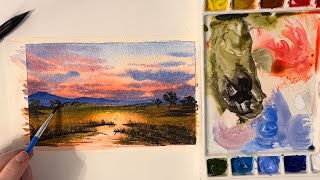
How to Paint Water Reflections in Watercolour | Easy 4 Step Boat Tutorial, by Richard Burton on YouTube. 17 min 22 s.
- Video length
- 17 min 22 s
- Time to do it
- 30 minutes
- Difficulty
- Easy
- Steps
- 8
What you need
Steps
Tape or hold your paper flat. Sketch the boat hull and mast lightly with a pencil, then mark a faint horizontal line where the water meets the sky.
Mix a pale blue grey for the water. Keep it weaker than you think you need, because reflections are always lighter and duller than the object above them.
Paint the calm water area with clean horizontal strokes, leaving a dry gap around the boat so the reflection sits directly below the hull.
Paint the boat in its main colours, then load the brush with the same colours and paint the reflection straight down from the hull while the water is still damp.
Drag the reflection colour downward in short vertical or slightly wavy strokes. Break the edges so the reflection looks soft and rippled, not solid.
Add darker tones close to the hull and lighter tones further out. This gives depth and makes the water look like it has distance.
Leave a few small white gaps or lift paint with a clean damp brush for highlights and light glints on the water.
Let the painting dry fully, then check the balance. Deepen the darkest reflection areas if the water looks flat, and soften any hard edges with clean water.
Tips and common mistakes
Keep reflections lighter, cooler and less detailed than the boat itself, or the water will look like a mirror.
Paint the reflection while the water area is damp but not soaking, so the colours blend softly.
Use horizontal strokes for the water surface and vertical strokes for the reflection to separate the two.
Test colours on scrap paper first so you do not overload the main painting.
Questions
Do I need special watercolour paint for reflections?
No. A basic set with a blue, a grey or black, and a warm brown or ochre is enough. Mixing your own greys gives more natural water tones.
Why does my reflection look too dark?
Reflections are usually lighter and duller than the object. Add more water to your mix and use less pigment for the reflected shape.
Can I fix a reflection that went wrong?
Yes, if the paint is still damp. Lift colour with a clean damp brush or paper towel, then repaint more softly once it dries.
This guide was drafted from the video's details and general task knowledge. It has not been checked against the full video. Check the video and relevant product instructions before following a procedure. Report a correction.