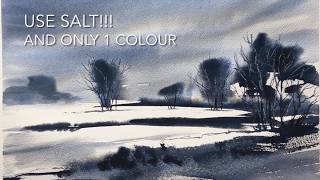
You will paint a small seascape in watercolour, from the first pale sky wash to the last foam highlights, using masking fluid to keep the white of the paper clean. It suits beginners with a few basic colours and brushes. Use cold pressed paper and let each layer dry fully.
YouTube video: Step by Step Seascape Watercolour Tutorial
Caption availability is unknown. Check the CC control in the YouTube player.
- Video length
- 21 min 22 s
- Time to do it
- 1 hour
- Difficulty
- Medium
- Steps
- 9
What you need
Steps
Tape your paper to a board with washi tape on all four edges. Keep the board at a slight tilt so washes run downwards and pool at the bottom.
Draw a light pencil horizon line about two thirds down the paper. Sketch a low headland or a few rocks at one side, keeping the marks faint.
Mix a pale wash of Hansa Yellow Light with a touch of Raw Sienna. Paint the sky with the 1 inch flat brush, adding clean water at the horizon so the colour fades.
While the sky is still damp, drop in a little Cerulean or Cobalt Teal near the horizon for haze. Leave it to dry completely before the next layer.
Dip an old brush in masking fluid and paint the areas you want to stay white: breaking wave crests, foam lines and the tops of rocks. Wash the brush with soapy water straight after.
Paint the sea with a size 10 round. Use Cerulean and Cobalt Teal for shallow water near the shore and Ultramarine for the deeper distance, letting the colours blend on the paper.
Add the rocks and headland with Paynes Grey, Burnt Sienna and a little Alizarin Crimson. Work on dry paper so the edges stay crisp, and leave lighter gaps for sunlit faces.
Wait until the paper is bone dry, then rub the masking fluid away with your finger or a remover block. Peel gently so you do not tear the surface.
Soften any hard masked edges with a clean damp brush. Add a few final dabs of foam and darker shadows to finish the scene.
Tips and common mistakes
Never use a good brush for masking fluid, because the latex ruins the bristles.
Let the paint dry fully before removing masking fluid, or you will smudge the layers underneath.
Test each mixed colour on scrap paper first, since watercolour dries lighter than it looks when wet.
Keep sky and distance washes pale and save your strongest darks for the rocks and foreground.
Questions
Can I put masking fluid on wet paper?
No. Apply it only to dry paper, or it will soak into the surface and be hard to remove cleanly.
How long does masking fluid take to dry?
Usually 10 to 15 minutes. It is ready when it feels dry and tacky-free to a light touch, and a cool hairdryer speeds it up.
Do I need masking fluid to paint a seascape?
No. You can paint around the white areas instead, but masking fluid makes crisp foam and wave highlights much easier for beginners.
The notes are drafted automatically from video details and general task knowledge. How the guide was prepared
Report a correction