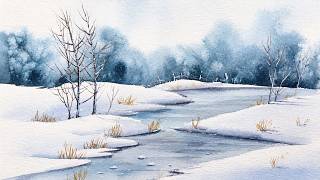
You will paint a small, loose autumn landscape in watercolour without drawing a sketch first. It suits beginners who want to practise soft skies, expressive trees and simple texture tricks. All you need is a few warm and cool colours, a round brush and a small sheet of cold press paper.
YouTube video: 5 Minute! Autumn Watercolour for Beginners | No Sketch Needed!
Caption availability is unknown. Check the CC control in the YouTube player.
- Video length
- 4 min 49 s
- Time to do it
- 20 minutes
- Difficulty
- Easy
- Steps
- 8
What you need
Steps
Tape your paper to a board so it stays flat while you work wet. Keep the sheet small, around 5 x 7 inches, so the painting stays quick.
Wet the top of the paper with clean water, then drop in Cerulean Blue for a soft sky. Let the colour fade and thin as it moves down the page.
While the sky is still damp, touch in Raw Sienna and Light Red near the horizon. This gives a warm, misty distance behind the trees.
Load a No.10 round brush with Raw Sienna, Sepia and Light Red and paint loose autumn tree shapes. Keep your strokes relaxed and let the colours mix on the paper.
Drag a palette knife lightly through the damp tree paint to lift a few trunks and branches. This adds texture and small flashes of light.
Sprinkle a few grains of table salt onto the wet foreground. Leave it to dry completely, then brush the salt away for speckled texture.
Switch to the No.6 round and the No.1 liner to paint loose grasses and stems across the foreground. Vary the height and direction of each stroke.
Use the 3/0 detail brush to dot in tiny autumn flowers and small touches of foliage. Stop while the marks still look fresh and unplanned.
Tips and common mistakes
Let each layer dry before adding the next, or the colours turn muddy.
Test the salt on a scrap of wet paper first so you know how much texture you will get.
Keep the sky pale and leave white paper showing for light.
Work fast with the big brush and avoid going back over a stroke you already made.
Questions
Do I need to sketch the scene first?
No. The painting is built straight onto the paper with brushstrokes and colour, so no drawing is needed. If you feel unsure, mark the horizon lightly with a fingertip.
Can I use different colours?
Yes. A bright orange or warm red can stand in for a specialist gold colour, and any similar blue or brown will work. Stick to three or four colours so the mixes stay clean.
What does the salt do?
Salt pulls pigment away as it dries and leaves pale speckles, which look like grit and fallen leaves. Add it only to damp paint, not a soaking wet puddle.
The notes are drafted automatically from video details and general task knowledge. How the guide was prepared
Report a correction