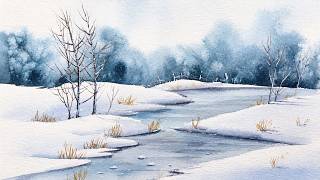
You will paint a simple landscape using only a red, a yellow, a blue and titanium white. It suits total beginners and anyone who wants to practise colour mixing and wet-on-wet brushwork without buying a big set of paints. A reference photo and a canvas or panel are the only extras you need.
YouTube video: Paint a Landscape with Just 3 Colors (Easy Oil Painting for Beginners)
Caption availability is unknown. Check the CC control in the YouTube player.
Choose a chapter (10)
- Video length
- 9 min 58 s
- Time to do it
- 1 hour
- Difficulty
- Easy
- Steps
- 7
What you need
Steps
Lay out one red, one yellow and one blue on your palette with titanium white. Keep the piles spaced apart so you can mix cleanly between them.
Choose a reference photo with a few big, clear shapes and obvious light and shadow. Skip busy scenes with lots of small detail for this study.
Mix thin, wet paint and block in the large masses: sky, distant shapes, ground and trees. Ignore detail and work loosely at this stage.
Hold your brush at a low angle and lay paint on top of the wet layer instead of scrubbing. Light touches keep the colours underneath from turning muddy.
Build a second layer over the first, adjusting values and colour temperature. Cooler, lighter colours in the distance make the scene read as deeper.
Load a brush with thicker paint and drag it upward for grasses and tree edges. Use a few confident strokes rather than many small ones.
Step back often and stop when the big shapes and light read clearly. Extra fussing tends to flatten a painting rather than improve it.
Tips and common mistakes
Mix only two colours at a time and clean the brush between mixes so you avoid dull, muddy greys.
Keep distant hills and trees cooler and lighter than foreground objects to create depth.
Use less solvent in each new layer so the paint sits on top instead of dissolving what is underneath.
Work in a ventilated room and keep solvent and oil-soaked rags away from flames and your skin.
Questions
Do I really only need three colours?
Yes. A red, a yellow, a blue and white will mix a wide range of landscape greens, browns and greys. You get more colour harmony and learn faster than with a big set.
Which red, yellow and blue should I buy?
Pick a warm red such as alizarin crimson, a yellow such as yellow ochre or cadmium yellow, and a blue such as ultramarine. These three give a balanced mixing range.
Can I do this with acrylics instead?
Yes, the same limited palette and wet-on-wet approach works with acrylics. Add a retarder or keep the surface damp, since acrylics dry much faster than oils.
The notes are drafted automatically from video details and general task knowledge. How the guide was prepared
Report a correction