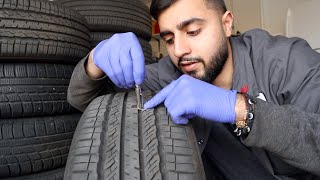
How to Measure Tire Tread Depth on your Car & Why it's Important, by 4DIYers on YouTube. 5 min 8 s.
- Video length
- 5 min 8 s
- Time to do it
- 10 minutes
- Difficulty
- Easy
- Steps
- 8
What you need
Steps
Park on a level surface, set the parking brake, and leave the engine off. Look along the tire shoulder for small arrows that point to the wear bars.
Find the raised wear bars inside the main tread grooves. If the tread surface is level with a wear bar, the tire is worn out and needs replacing.
Extend the plunger on the tread depth gauge fully. Press the gauge into a main groove, not onto a wear bar, and keep the outer flange flat on the tread.
Push the plunger down until it stops, lift the gauge out, and read the depth where the case meets the scale. Most gauges show both imperial and metric marks.
Measure the inner, center, and outer edge of the tread on each tire. Write down each number so you can compare the pattern across the tread face.
Repeat the checks on all four tires. A middle reading that is lower than the edges often points to overinflation, while low edges can point to underinflation.
Use a vernier caliper if you do not have a gauge. Extend the depth blade, rest the caliper body on the tread, push the blade into the groove, and read the scale.
Compare your lowest reading with your local legal minimum. Replace tires at the wear bars or at the legal limit, and check for uneven wear across the axle.
Tips and common mistakes
Check tread depth when tires are cold and clean, because dirt or heat can change the reading.
Measure at least three points across each tire, since inner and outer edges wear differently.
Rotate tires about every 8,000 miles or 12,000 km to help keep tread wear even.
Do not rely on a visual check alone, because a tire can look fine and still be near the legal limit.
Questions
What tread depth is legal?
Rules vary by country and vehicle type. In the US, many states use 2/32 inch (1.6 mm) as the minimum, so check your local rules.
How often should I check tire tread?
Check once a month and before long trips. Also check after hitting a curb or noticing uneven wear.
Can I use a coin instead of a gauge?
Yes, a coin can give a rough check, but a tread depth gauge or caliper gives a more accurate number.
This guide was drafted from the video's details and general task knowledge. It has not been checked against the full video. Check the video and relevant product instructions before following a procedure. Report a correction.