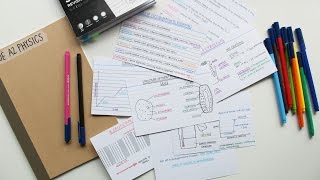
You will build your own revision pack from your exam board specification, turning each topic into flashcards, a mind map and practice questions. It suits students revising for GCSE, A-level or university exams who want active materials instead of just rereading notes. You only need your syllabus, paper, index cards and past papers to start.
YouTube video: how to create revision resources 📚
Caption availability is unknown. Check the CC control in the YouTube player.
- Video length
- 1 min 21 s
- Time to do it
- 2 hours
- Difficulty
- Easy
- Steps
- 8
What you need
Steps
Print or open your exam board specification and read the topic list for each unit. Tick the topics you have been taught and number them so you have a checklist to work through.
Make one mind map per unit on a sheet of A3 or a double page. Put the unit name in the centre and branch out with each sub-topic, keeping it to keywords only.
Write flashcards for facts you must recall: definitions, formulas, dates and key terms. Put one question on the front and a short answer on the back.
Test yourself on each card and sort them into two piles, known and not known. Only keep the not known cards in daily rotation.
Condense each topic into a single page of notes using your own words. Use bullet points, arrows and diagrams rather than full sentences.
Pull questions from past papers and mark schemes for each topic and write them on strips of paper. Add the mark scheme points on the back so you can check yourself.
Do a blank page test for one topic: close your notes, write everything you remember, then fill the gaps in a different colour pen.
Schedule short review slots, about 15 minutes each, for the cards and questions you got wrong. Revisit them after one day, one week and one month.
Tips and common mistakes
Keep cards to one fact each, because long cards are hard to test yourself on.
Write in your own words rather than copying the textbook, so you have to process the idea.
Make resources for the topics you find hardest first, not the ones you enjoy.
Check your notes against the specification so you do not revise topics that are not examined.
Questions
How many flashcards should I make?
Aim for one card per fact you need to recall, so a topic might give you 15 to 30 cards. Fewer, well-written cards beat a huge deck you never review.
Are typed notes or handwritten ones better?
Both work, but handwriting diagrams and formulas helps memory and is faster to sketch. Type long lists if you need to search them later.
How often should I review my resources?
Short reviews spread over days and weeks work better than one long session. Revisit the cards you got wrong after a day, then a week, then a month.
The notes are drafted automatically from video details and general task knowledge. How the guide was prepared
Report a correction