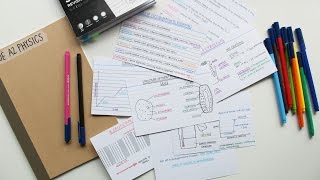
You will build a set of flashcards you can actually test yourself with, using your notes and the exam specification. It suits A-Level Business students revising definitions, formulas and case studies. All you need is card, a pen and your class notes.
YouTube video: How to make flashcards that work | A-Level Business
Caption availability is unknown. Check the CC control in the YouTube player.
- Video length
- 1 min 21 s
- Time to do it
- 20 minutes
- Difficulty
- Easy
- Steps
- 7
What you need
Steps
Collect your source material: class notes, the exam board specification and a few past paper mark schemes. Work through one topic at a time so the cards stay focused.
Write one question or prompt on the front of each card. Keep it to a single fact, definition or process, such as What is break-even?
Put the answer on the back in your own words. Lead with the key term or formula, then add the short explanation.
Copy definitions using the specification wording, and add a quick business example, such as a named case study, where it helps.
Number or colour code the cards by topic so you can shuffle them into separate piles later.
Test yourself: read the front, say the answer aloud, then check the back. Split the cards into a know pile and a do not know pile.
Run the do not know pile again the next day. Only add new cards once the old ones are sticking.
Tips and common mistakes
Keep one idea per card, since cards with five facts on them are hard to test yourself on.
Write the answers yourself rather than copying them, because the act of rewording helps you remember.
Do not make cards for everything. Focus on definitions, formulas and lists you keep forgetting.
Add a worked calculation to cards for finance topics like break-even or gross profit margin.
Questions
How many flashcards should I make?
Aim for 20 to 30 cards per unit, covering the key terms and formulas. Add more only when those are secure.
Paper cards or a flashcard app?
Either works. Paper is quick to sort into piles, while apps like Anki add automatic spaced repetition for you.
How often should I review them?
Little and often beats one long session. Run a pile daily for a week, then drop to once a week.
The notes are drafted automatically from video details and general task knowledge. How the guide was prepared
Report a correction