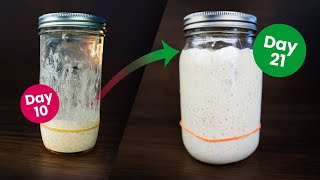
Make a crusty beginner sourdough loaf with just flour, water, salt and an active starter. This guide walks you through mixing, stretch and folds, shaping and baking in a Dutch oven. It suits anyone on their first few loaves and needs a starter that is fed and bubbly.
YouTube video: The BEST Beginner Sourdough Bread Tutorial on YouTube
Caption availability is unknown. Check the CC control in the YouTube player.
Choose a chapter (11)
- Video length
- 12 min 1 s
- Time to do it
- 1 day, mostly hands off
- Difficulty
- Medium
- Steps
- 10
What you need
Steps
Feed your starter 4 to 12 hours before you bake. Wait until it has doubled, looks domed and smells slightly sour, then use it at its peak.
Weigh 500 g bread flour, 350 g water, 100 g starter and 10 g salt into a bowl. Mix with your hand until no dry flour is left.
Cover and rest the dough 30 minutes. Then do four sets of stretch and folds, one set every 30 minutes, lifting and folding the dough over itself.
Leave the dough to bulk ferment at room temperature for 4 to 6 hours. It is ready when it has grown by about half and feels jiggly and light.
Turn the dough onto a lightly floured counter and preshape it into a loose round. Cover and rest it for 20 to 30 minutes.
Flour the top, flip the dough and fold it into a tight oval. Place it seam side up in a floured banneton or a towel-lined bowl.
Proof for 1 hour at room temperature, or cover and chill it in the fridge for 12 to 24 hours for a better flavour and easier scoring.
Heat the oven to 230 C or 450 F with the Dutch oven inside for at least 45 minutes. Cold dough going into a hot pot gives the best rise.
Tip the dough onto parchment, score a shallow line or cross about 1 cm deep with a lame or sharp knife, then lower it into the hot pot.
Bake covered for 20 minutes, then uncover and bake 20 to 25 minutes more until deep brown. The loaf should reach about 96 C or 205 F inside.
Tips and common mistakes
Use a starter that has clearly doubled, or the loaf will be dense and slow to rise.
Keep the dough around 24 to 26 C during the bulk rise, since a cold kitchen slows fermentation a lot.
Dust the banneton with rice flour, which releases from the dough more cleanly than wheat flour.
Let the loaf cool for at least an hour before slicing so the crumb can set.
Questions
How do I know when the bulk fermentation is finished?
Look for a 50 to 75 percent rise, a domed top and small bubbles around the edge. The dough should feel airy and jiggle when you shake the bowl.
Do I need a banneton basket?
No. A bowl lined with a well-floured tea towel works fine and holds the shape during the final proof.
Why did my sourdough come out flat and dense?
It was usually under-fermented or the starter was not active enough. Check that your starter doubles after feeding and give the dough more time if your kitchen is cool.
The notes are drafted automatically from video details and general task knowledge. How the guide was prepared
Report a correction