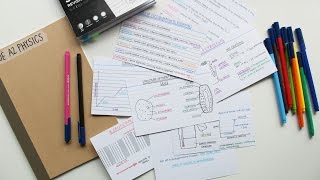
You will learn to build flashcards that test real understanding instead of just recognition, and to review them on a spaced schedule. It suits students revising for exams who are willing to write their own cards. You only need card stock or a flashcard app and your notes.
YouTube video: ARE YOU MAKING FLASHCARDS WRONG⁉️🤯📚
YouTube’s video details do not confirm captions. Check CC in the player for available tracks.
- Video length
- 1 min 49 s
- Time to do it
- 30 minutes
- Difficulty
- Easy
- Steps
- 8
What you need
Steps
Go through your notes and pick out the facts, definitions and formulas you actually need to recall in the exam. Skip anything you already know cold.
Write one question on the front of each card and the answer on the back. Keep each card to a single idea so you can grade yourself clearly.
Phrase questions so you must produce the answer from memory, not just recognise it. Avoid true or false and multiple choice cards.
Add a short cue or example on the answer side when a fact is easy to confuse with another. Keep it brief.
Shuffle the deck and go through it, saying each answer out loud before you flip the card.
Sort cards into two piles: ones you got right and ones you missed. Put the missed cards back in the deck sooner.
Review the deck again the next day, then space the reviews further apart, for example every three days and then weekly.
Rewrite or retire cards you keep missing after several reviews. A card you never get right is usually worded badly.
Tips and common mistakes
Keep cards short. Long paragraphs on a card make recall harder, not easier.
Test yourself before looking at the answer, even if you are unsure. Guessing then checking beats rereading.
Mix old cards into each session so earlier topics do not fade.
Write cards by hand if you can. The act of writing helps you remember the content.
Questions
How many cards should I make?
Start with a small deck of 20 to 30 cards for one topic. A huge deck made in one sitting is hard to review and easy to abandon.
Can I use a flashcard app instead of paper?
Yes. Apps handle spacing and shuffling for you, but writing the cards yourself still matters more than the format.
How often should I review?
Review the day after you make the deck, then every few days, stretching the gap each time you get a card right.
The notes are drafted automatically from video details and general task knowledge. How the guide was prepared
Report a correction