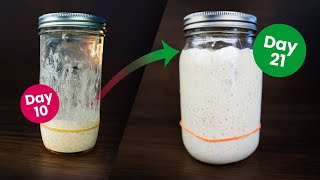
You will grow a sourdough starter from flour and water and learn how feeding, hydration and temperature change how sour the bread tastes. It suits beginners who want a reliable starter and some control over flavour. All you need is flour, water, a jar and a scale.
YouTube video: Mastering Your Sourdough Starter - A deep dive into Flavor and Acidity
Caption availability is unknown. Check the CC control in the YouTube player.
Choose a chapter (7)
- Video length
- 8 min 12 s
- Time to do it
- 7 days
- Difficulty
- Easy
- Steps
- 8
What you need
Steps
Weigh 50 g wholemeal flour and 50 g water into a clean jar. Stir into a thick paste, scrape the sides down and cover the jar loosely.
Leave the jar at room temperature, roughly 22 to 25 C, for 24 hours. Bubbles and a sour smell should start to appear.
Each day, throw away half the starter and feed the rest with equal weights of flour and water, for example 50 g of each.
Keep feeding once a day for 5 to 7 days. The starter is ready when it doubles in size within 4 to 6 hours of a feed.
Bake when the starter has risen to a domed top and is just starting to fall. That is when it gives the fluffiest dough.
For a milder, more lactic flavour, keep the starter wet at 100 percent hydration and store it somewhere warm. Feed it more often.
For a more sour, vinegary loaf, make the starter stiffer at about 60 to 65 percent hydration and let it ferment cooler and longer between feeds.
Keep a spare jar of fed starter in the fridge as a backup. Feed it once a month and let it warm up before you bake.
Tips and common mistakes
Always feed by weight on a scale, not by eye, so the hydration stays consistent.
Temperature is the biggest lever on flavour, so move the jar somewhere cooler for more sourness and warmer for mildness.
Use the starter at its peak rather than after it collapses, or the bread will taste flat and the dough will spread.
Avoid chlorinated tap water if your starter rises slowly, and keep the jar rim clean to stop mould.
Questions
How do I know my starter is strong enough to bake with?
It should double within 4 to 6 hours of a feed and smell pleasantly sour, not like nail polish. If it only bubbles slightly, keep feeding daily for a few more days.
Why is my bread not sour enough?
Your starter is probably fermenting warm and wet, which pushes lactic acid. Try a stiffer starter and a cooler, longer fermentation to build more acetic acid.
Can I keep the starter in the fridge all the time?
Yes, but it slows down and turns more sour. Take it out, feed it two or three times at room temperature before you bake.
The notes are drafted automatically from video details and general task knowledge. How the guide was prepared
Report a correction