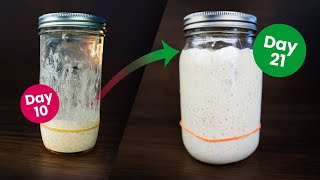
You will mix flour and water in a jar and let wild yeast take over, then feed it on a schedule until it is bubbly and mature. This suits beginners who want a low-effort starter with no special equipment beyond a scale and a container. You only need flour, water, salt later, and about a week of waiting.
YouTube video: The Easiest Way to Make Sourdough Starter (for lazy people)
YouTube’s video details do not confirm captions. Check CC in the player for available tracks.
- Video length
- 59 min 11 s
- Time to do it
- 1 week
- Difficulty
- Easy
- Steps
- 10
What you need
Steps
In a 1-quart container, combine 4oz (113g) flour and 4oz (113g) water. Stir well and scrape down the sides.
Wipe the inside walls of the container clean with a paper towel. Cover it securely, but do not make an airtight seal that could let pressure build up.
Do not use a cloth or paper towel as a cover. The lid must not let air circulate across the starter.
Leave the container on the countertop for 1 week, or until a layer of liquid called hooch gathers at the top, middle or bottom.
For feeding 1, stir well, discard half the starter, then add 2oz (57g) flour and 2oz (57g) water. Clean the sides and sit on the countertop for 48 hours, or until hooch gathers.
Repeat the same discard and feed for feeding 2 and feeding 3, waiting 48 hours or until hooch gathers each time.
For feeding 4, stir well and weigh 4oz (113g) starter into a large bowl. Add 12oz (340g) filtered water, 1 lb 4oz (567g) flour and 0.7oz (20g) salt, then follow the normal steps for making simple sourdough.
Give the starter container a fourth feeding with 2oz (57g) flour and 2oz (57g) water. If the dough doubles in 24 hours or less at room temperature, your starter is mature.
If it does not double, switch to a 24 hour feeding cycle and continue the discard and feedings for 2 or 3 more cycles, then test again.
When mature, move the starter to a larger container and give a large feeding, for example 12oz flour and 12oz water. Cover, leave on the countertop for several hours until bubbly, then refrigerate.
Tips and common mistakes
If your starter molds, start over and add 2 drops of distilled white vinegar to the initial mix.
If it molds again after the vinegar, buy a mature starter online, since your home may be heavily colonized by mold.
Never pour hooch off a starter kept in the fridge. Stir it back in before measuring or feeding.
Feed only when you run low on starter and need more, even if that is every few months.
Questions
How do I know my starter is ready?
It is mature when the dough doubles in 24 hours or less at room temperature. If it does not, keep feeding on a 24 hour cycle for a few more rounds and test again.
Can I cover the jar with a cloth?
No. Use a lid that is secure but not airtight. A cloth or paper towel lets too much air circulate across the starter.
What is hooch?
Hooch is a layer of liquid that gathers at the top, middle or bottom of the starter. Its appearance tells you when to move to the next feeding.
The notes are drafted automatically from video details and general task knowledge. How the guide was prepared
Report a correction