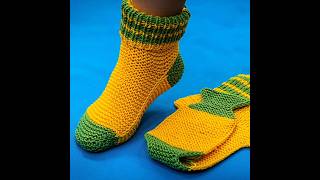
How to Knit Socks in 7 Stages: Stage 2 - Leg and Heel Flap, by Little Green Shed Creative on YouTube. 8 min 2 s.
- Video length
- 8 min 2 s
- Time to do it
- 1 hour
- Difficulty
- Easy
- Steps
- 7
What you need
Steps
Pick up where your cuff ended, with the stitches still divided over your needles. Knit every round in stocking stitch, or follow the rib or texture your pattern gives for the leg.
Work round after round until the leg measures the length in your pattern. For a standard crew sock that is usually about 18 cm (7 in) from the cast on edge.
Slip the leg over your foot or hold it against your ankle. Stop when the top sits where you want it, just above the ankle bone.
Move half your stitches onto one needle for the heel flap. With 64 stitches that means 32 working stitches, with the other 32 resting on the remaining needles.
Work the flap flat in rows, back and forth, not in the round. Slip the first stitch purlwise, knit to the end, then turn.
Next row: slip the first stitch purlwise, then purl to the end and turn. Repeat these two rows until the flap has as many rows as it has stitches, for example 32 rows.
Check the flap looks square with neat edges. Leave the stitches on the needle and move on to the heel turn in the next stage.
Tips and common mistakes
Slipping the first stitch of every row gives a firmer flap and makes picking up gusset stitches much easier later.
Keep a stitch marker at the start of the round so you always know where the leg ends and the flat flap begins.
Count your flap rows with a counter or a note, because an uneven flap twists the sock sideways on the foot.
Keep the slipped edge stitches relaxed, not tight, or you will struggle to pick them up after the heel turn.
Questions
How long should the leg be before I start the heel?
Measure from the cast on edge and aim for about 18 cm (7 in) for a crew sock, or shorter for an ankle sock. Your pattern length wins if it gives one.
Why do I stop knitting in the round for the heel flap?
The flap is worked flat so it builds a double thickness of fabric under the back of the heel. That flat square is what the heel turn is shaped into.
Do I need different needles for the heel flap?
Not usually. Some knitters switch to a needle one size smaller for a denser flap, but the same needles are fine if your tension is even.
This guide was drafted from the video's details and general task knowledge. It has not been checked against the full video. Check the video and relevant product instructions before following a procedure. Report a correction.