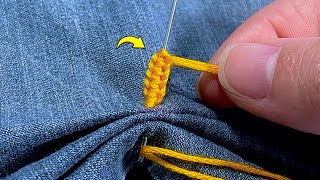
How to Invisibly Repair a Hole in a Knit Sweater at Home, by Sunny TV on YouTube. 4 min 43 s.
- Video length
- 4 min 43 s
- Time to do it
- 20 minutes
- Difficulty
- Easy
- Steps
- 9
What you need
Steps
Turn the sweater inside out and stretch the hole area gently over a darning mushroom or a smooth round object so the stitches sit flat.
Trim any loose, frayed yarn around the hole with small scissors, but leave the healthy stitches alone.
Thread a length of matching yarn through the blunt needle. Use a single strand for thin knits and two for thicker ones.
Work from the wrong side. Bring the needle up through a solid stitch just below the hole and pull the yarn through.
Sew small running stitches across the gap, following the direction of the original knit stitches, not straight across.
Fill the hole row by row, catching a sound stitch on each side so the new yarn links into the existing fabric.
Check the right side as you go. The new stitches should sit at the same tension as the knit around them, not pulled tight.
Finish with a small backstitch on the inside, then weave the yarn tail through a few stitches and cut it close.
Press the mended spot lightly under a damp cloth, or steam it, so the new yarn relaxes and blends in.
Tips and common mistakes
Use yarn the same colour as the sweater for a truly invisible mend. Bright contrast wool only helps you see the technique.
Do not pull the stitches tight or the repair will pucker and show.
Work on the inside of the sweater so the new stitches hide behind the knit.
Fix small holes early before they grow and the yarn starts to unravel.
Questions
Can I repair a sweater hole without matching yarn?
It will be harder to hide. Pick the closest shade you have, or use a single ply pulled from an inside seam so the colour matches exactly.
Do I need a sewing machine?
No. A blunt needle and matching yarn are enough for small holes. A machine is only useful for larger, structural repairs.
What if the hole is bigger than a coin?
Large holes need a woven darn or a patch. This hand method works best on small holes up to about 2 cm across.
This guide was drafted from the video's details and general task knowledge. It has not been checked against the full video. Check the video and relevant product instructions before following a procedure. Report a correction.