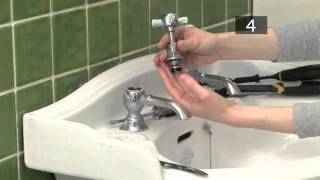
Swap a faulty bottom entry fill valve for a new adjustable one and stop a toilet that runs, trickles or hisses. It suits a first-time DIY plumber working on a standard cistern where the water pipe comes up through the floor of the tank. You only need a spanner, a sponge and the new valve.
YouTube video: How to Install a Bottom Entry Fill Valve in your Toilet Cistern.
Caption availability is unknown. Check the CC control in the YouTube player.
- Video length
- 4 min 49 s
- Time to do it
- 30 minutes
- Difficulty
- Easy
- Steps
- 9
What you need
Steps
Turn off the water at the isolation valve on the supply pipe, or at the mains stopcock if there is none. Flush the toilet and sponge out the water left in the cistern.
Hold the valve body and undo the supply nut underneath the cistern with an adjustable spanner. Expect a little water to drip out, so keep the cloth and bucket handy.
Unscrew the plastic back nut on the old valve inside the cistern and lift the valve out through the top of the tank.
Wipe the inside of the cistern and clean the hole in the base so the new rubber washer sits flat.
Push the new valve shank up through the hole from underneath. Slide the rubber washer over it inside the cistern, then hand-tighten the back nut and give it a quarter turn with the spanner.
Adjust the height of the valve body so the float arm clears the cistern lid and the valve sits level. Most valves twist or slide to set this.
Reconnect the supply pipe to the new shank and tighten the nut firmly by hand, then a nip with the spanner. Do not force it.
Turn the water back on and let the cistern fill. Check the shank and supply nut for leaks and tighten slightly if you see drips.
Check the instructions for your exact model before choosing this setting or amount. Flush twice and check the valve shuts off cleanly.
Tips and common mistakes
Overtightening the plastic back nut is the most common mistake and can crack the cistern base, so hand-tight plus a quarter turn is enough.
Make sure the rubber washer sits on the inside of the cistern, not under the tank, or it will leak.
If your new valve runs on, check the water level first before taking anything apart again.
A toilet that hisses or fills slowly often just needs a new valve rather than a whole cistern.
Questions
How do I know if I need a bottom entry or side entry valve?
Look under the cistern. If the water pipe comes up through the floor of the tank, you need a bottom entry valve. If it comes in through the side wall, you need a side entry one.
Why is my new fill valve still running?
The water level is probably set too high, or the float is catching on the cistern wall. Lower the level with the adjustment screw and check the float moves freely.
Can I do this without turning off the mains?
Only if your toilet has a working isolation valve on the supply pipe. If it does not, turn off the mains stopcock before you start.
The notes are drafted automatically from video details and general task knowledge. How the guide was prepared
Report a correction