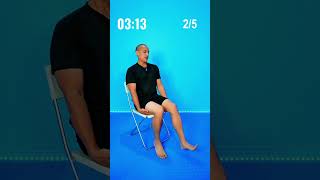
You will test your balance with a 10-second one-leg stand, find your weaker side and train it with a simple daily drill called the Golden Rooster. It suits anyone over 50 who wants steadier footing and fewer stumbles. All you need is bare feet, a hard floor and something solid to hold.
YouTube video: If You Can’t Stand on One Leg for 10 Seconds After 50, Watch This
Caption availability is unknown. Check the CC control in the YouTube player.
Choose a chapter (9)
- Video length
- 12 min 42 s
- Time to do it
- 10 minutes
- Difficulty
- Easy
- Steps
- 7
What you need
Steps
Clear a patch of floor and stand barefoot next to a counter, wall or heavy chair you can grab with one hand. Keep that support within reach the whole time.
Stand tall with arms at your sides. Lift one foot a few inches off the floor and start the timer. Stop when your foot touches down or you grab the support.
Repeat on the other leg and write down both times. Note which leg gave out first and how many seconds each side held.
Do the eyes-closed version only if you can already hold 10 seconds with eyes open, and only with a helper standing beside you. Most people fail this one at first, so don't be surprised.
Practise the Golden Rooster twice a day. Lift one foot, rest the sole lightly against your other calf or ankle, and hold for 30 seconds while breathing normally.
Swap sides and hold 30 seconds on the other leg. Give the weaker leg the same time, not less, even if you wobble more.
Once 30 seconds feels steady, build up toward 60 seconds, then try slow head turns or letting go of the counter for a few seconds at a time.
Tips and common mistakes
Keep your eyes on a fixed point at eye level rather than looking down at your feet.
Bare feet on a hard floor give better feedback than thick socks or soft carpet.
Breathe normally and keep your standing knee soft, not locked straight.
Skip the eyes-closed version alone and see a doctor if you cannot hold 5 seconds, get dizzy often or have numb feet.
Questions
How long until my balance improves?
Most people notice small gains within the first week of twice-daily practice, with clearer changes by about a month. The key is doing it every day rather than in one long session.
Should I train my good leg too?
Yes. Train both sides equally, since the weaker leg improves faster when the stronger one keeps its edge. Uneven training tends to keep the gap open.
Can I do this if I have knee or hip pain?
Try a shorter hold, a lower lift or hold the counter with both hands. Stop if it hurts, and check with a doctor or physiotherapist before continuing.
The notes are drafted automatically from video details and general task knowledge. How the guide was prepared
Report a correction