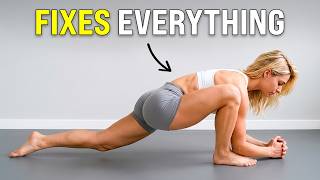
A short daily routine of desk setup tweaks and mobility moves that eases the rounded shoulders and tight hips that come from sitting all day. It suits anyone at a computer who wants a simple, no-equipment fix they can do at their desk. You only need a chair, a wall or door frame, and a timer.
YouTube video: If desk job has ruined your posture, comment “mobility” and let’s fix it together 🥰 #mobility
Caption availability is unknown. Check the CC control in the YouTube player.
- Video length
- 1 min 26 s
- Time to do it
- 10 minutes
- Difficulty
- Easy
- Steps
- 8
What you need
Steps
Set your chair so your feet sit flat and your hips are level with or slightly above your knees. Raise your screen so the top is at eye level and keep the keyboard close enough that your shoulders stay relaxed.
Do chin tucks. Sit tall, pull your chin straight back to make a double chin, hold for 5 seconds, then release. Repeat 10 times.
Open your chest in a doorway. Place your forearms on the frame, step one foot through and lean gently until you feel a stretch. Hold 20 to 30 seconds per side.
Extend your upper back over the chair back. Clasp your hands behind your head, keep your lower ribs down and arch slowly over the chair. Do 8 to 10 slow reps.
Squeeze your shoulder blades. Pull them back and down without shrugging, hold for 5 seconds, then relax. Repeat 10 times.
Stretch your hip flexors. Kneel on one knee, tuck your pelvis under and shift your weight forward slightly until the front of the back hip stretches. Hold 30 seconds each side.
Stand up and walk for 2 minutes every 30 to 45 minutes of sitting. Set a timer so you actually get up.
Finish with 10 slow wall slides or a short walk to reset your shoulders before you go back to work.
Tips and common mistakes
Do the routine twice a day rather than one long session, since small frequent breaks beat occasional big stretches.
Stop at a gentle stretch, never at pain, and keep breathing instead of holding your breath.
Check your setup before you stretch, because a screen that sits too low will undo the work within an hour.
If pain runs down your arm or leg, or lasts for weeks, get it checked by a doctor or physiotherapist.
Questions
How long does it take to see better posture?
Most people feel looser after the first session, but visible change usually takes a few weeks of daily practice. Pair the stretches with regular standing breaks for faster results.
Can stretching alone fix my posture?
No. Stretching helps tight areas, but you also need strength work and a desk that fits your body. Treat the routine as one part of the fix, not the whole thing.
How often should I do this routine?
Twice a day works well, for example once mid-morning and once mid-afternoon. Keep it short and consistent rather than long and occasional.
The notes are drafted automatically from video details and general task knowledge. How the guide was prepared
Report a correction