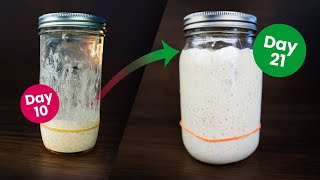
Keep a sourdough starter healthy with a simple 1:1:1 feeding of starter, flour and water. You will learn to spot a hungry starter, let it ripen at room temperature and store it in the fridge between bakes. It suits new bakers and needs a digital scale, a jar and flour.
YouTube video: Feeding and Maintaining a Sourdough Starter
Caption availability is unknown. Check the CC control in the YouTube player.
Choose a chapter (6)
- Video length
- 7 min 15 s
- Time to do it
- 10 minutes
- Difficulty
- Easy
- Steps
- 8
What you need
Steps
Look for signs of hunger: a dark liquid layer called hooch, a flat top, a sharp sour smell, or no rise after a recent feeding.
Weigh equal amounts of starter, flour and water. A 1:1:1 feed could be 50 g starter, 50 g flour and 50 g water.
Stir the starter and water together in the jar, then add the flour. Mix until no dry flour remains.
Scrape down the jar sides and mark the level with a rubber band or tape so you can see the rise.
Leave the jar loosely covered at room temperature, about 70 to 75 F. It should double and dome in about 4 to 8 hours.
Store a ripe starter in the fridge with a loose lid. Feed it at least once a week to keep it healthy.
To feed a cold starter, let it sit at room temperature for 30 to 60 minutes. Pour off any hooch, then feed it 1:1:1.
Let the fed starter sit at room temperature until bubbly and risen, then return it to the fridge or bake with it.
Tips and common mistakes
Use a digital scale for the 1:1:1 ratio; scooping flour by volume gives inconsistent results.
Do not screw the lid on tight; trapped gas can build pressure and crack the jar.
Discard all but a small amount before feeding if the jar gets too full.
Questions
How often should I feed a starter kept at room temperature?
Once or twice a day, especially after it has doubled and fallen. In the fridge, once a week is usually enough.
What is the dark liquid on top of my starter?
It is hooch, a sign the starter is hungry. You can stir it in for a sour flavor or pour it off before feeding.
How do I know my starter is ready to bake with?
It should be bubbly, doubled in size and domed on top. It should smell pleasantly yeasty and sour, not sharply acetone-like.
The notes are drafted automatically from video details and general task knowledge. How the guide was prepared
Report a correction