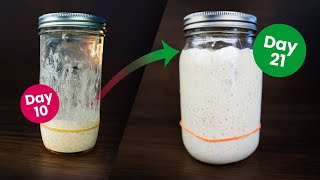
Keep a sourdough starter alive by feeding it by eye instead of weighing every gram. It suits beginners who want a low-stress routine and already have a jar of starter going. You only need flour, water, a jar and a spoon, plus a rough sense of equal parts.
YouTube video: How to feed your sourdough starter without being precise! #recipe #sourdoughstarter #baking
Caption availability is unknown. Check the CC control in the YouTube player.
- Video length
- 1 min 12 s
- Time to do it
- 5 minutes
- Difficulty
- Easy
- Steps
- 8
What you need
Steps
Take the lid off your starter jar and look at it. A thin layer of dark liquid on top or a sharp, sour smell means it is hungry and due for a feed.
Stir the starter down with a spoon so the liquid on top mixes back in and the whole jar looks even.
Tip out roughly half the starter into the bin, leaving about two or three tablespoons in the jar. Eyeballing this is fine.
Add about the same amount of flour as starter by eye, then pour in enough lukewarm water to make it stir easily.
Mix until no dry flour is left. Aim for a thick pancake batter texture, adding a splash more water if it looks stiff.
Scrape down the sides of the jar with the spoon so the starter sits in one level layer at the bottom.
Cover the jar loosely with its lid or a cloth and leave it at room temperature, out of direct sun.
Wait four to twelve hours until the starter has doubled, looks bubbly and smells yeasty and mild. Then feed it again.
Tips and common mistakes
Equal parts starter, flour and water by volume is the easy rule, so a cup of each works as well as a scale.
Use lukewarm water, not hot, because water above about 40C can kill the wild yeast you are trying to grow.
If your tap water is heavily chlorinated, leave it in an open jug for an hour or use filtered water instead.
Feed once a day at room temperature, or every few days in the fridge, and let it warm up before baking.
Questions
What if I forget to feed it for a week?
Pour off any dark liquid, feed it as normal and give it a few days of regular feeds. A neglected starter usually comes back unless it has mould on it.
Do I have to throw half away every time?
Yes, or the jar fills up fast and the food runs out before the yeast can use it. Give the spare to a friend or use it in pancakes and flatbreads.
How do I know it is ready to bake with?
It should double in size within four to eight hours of feeding, be full of bubbles and smell pleasantly sour rather than nail-polish sharp.
The notes are drafted automatically from video details and general task knowledge. How the guide was prepared
Report a correction