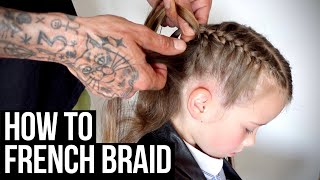
HOW to DUTCH BRAID your OWN HAIR! *for beginners, by Jonesy Jams on YouTube. 5 min 58 s.
- Video length
- 5 min 58 s
- Time to do it
- 15 minutes
- Difficulty
- Medium
- Steps
- 8
What you need
Steps
Brush all the knots out of dry hair and part it where you want the braid to start. Set out your hair ties and clip so you are not searching mid-braid.
Take a small section at the front or crown and split it into three even strands. Hold the outer strands in your left and right hands and the middle one between your fingers.
Cross the right strand under the middle strand, then cross the left strand under the new middle strand. Going under, not over, is what makes it a Dutch braid.
Before crossing the right strand again, add a thin slice of loose hair from the right side to it. Keep the strands close to your head and pull gently.
Cross that combined right strand under the middle. Then add a slice of loose hair from the left side to the left strand and cross it under the middle.
Repeat the add-and-cross pattern, right then left, working down the back of your head. Tidy each cross with your fingers before adding more hair.
When you reach the nape of your neck and no loose hair is left to add, plait the tail as a normal three-strand braid.
Tie the end with a clear elastic and gently tug the outer edges of each section outward to fatten the braid.
Tips and common mistakes
Braiding second-day, unwashed hair gives more grip and stops the strands slipping loose.
Hold each strand close to the scalp as you cross it, or the braid turns out loose and lumpy.
Keep the sections small near the front and take bigger slices as you move down.
Practise the under-cross motion on a loose ponytail first before you try it on your whole head.
Questions
What is the difference between a Dutch braid and a French braid?
In a French braid the strands cross over the middle, so the braid sits inside the hair. In a Dutch braid they cross under, which pushes the braid out so it looks raised.
Why does my Dutch braid keep coming out loose?
You are probably adding hair too far from the scalp or letting the strands spread out. Pinch each strand tight and add hair close to where the last cross ended.
Can I do this on short hair?
It works best on shoulder-length hair or longer, since you need enough length to keep adding sections. On short hair you may only manage one or two crosses before tying off.
This guide was drafted from the video's details and general task knowledge. It has not been checked against the full video. Check the video and relevant product instructions before following a procedure. Report a correction.