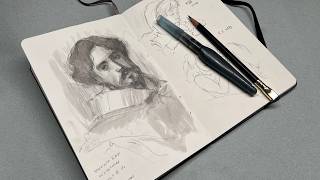
Architectural Ink Wash Rendering: A Classical Technique for Stunning Drawings, by Architect after hours on YouTube. 9 min 50 s.
- Video length
- 9 min 50 s
- Time to do it
- 45 minutes
- Difficulty
- Easy
- Steps
- 8
What you need
Steps
Draw your architectural subject in pencil first. Keep the lines light and get the proportions and perspective right before any ink goes down.
Go over the pencil drawing with a fine liner or dip pen. Use confident lines and vary the weight so edges and corners read more strongly.
Mix your washes in separate cups. Start with a light wash of a few drops of ink in water and make a darker one alongside it.
Test each wash on scrap paper of the same type. Let it dry, because ink looks lighter when wet than when dry.
Load the brush and paint a smooth even tone on a large area such as a wall or sky. Work quickly and keep a wet edge so you avoid streaks.
Build a stepped gradient by painting bands of increasing ink strength, or a smooth gradient by adding water as you go.
Layer washes to add depth. Let each layer dry fully before adding the next so the paper does not lift or buckle.
Add the darkest accents last, such as shadows under eaves or in windows. Keep these small so the drawing stays light.
Tips and common mistakes
Always test a wash on scrap paper first, since ink dries several shades lighter than it looks wet.
Keep your brush moving and don't go back over a drying wash, or you will lift the paper and leave blotches.
Tilt the board slightly so washes pool evenly instead of sitting in one spot.
Work from light to dark and stop early. It is easy to add ink but hard to take it away.
Questions
What kind of ink should I use for ink wash?
Waterproof black ink or India ink works well because it stays put when you add water. Avoid ink that smudges when wet.
Can I do ink wash on normal printer paper?
It will buckle and may tear. Use watercolour paper or heavy drawing paper that can take water without warping.
How do I fix a wash that came out too dark?
Let it dry and lift some colour with a clean damp brush and paper towel. If it is still too dark, add lighter areas around it to balance the tone.
This guide was drafted from the video's details and general task knowledge. It has not been checked against the full video. Check the video and relevant product instructions before following a procedure. Report a correction.