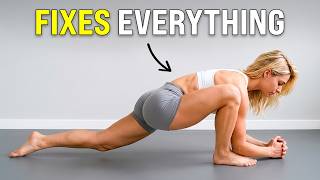
This guide walks you through six at-home moves for lower back pain that shows up when you stand or walk and eases when you sit. It suits anyone with mild ongoing pain and no serious symptoms. You need a mat and a little floor space.
YouTube video: Back Pain When Standing or Walking? A Physical Therapist's 6 Best Exercises
Caption availability is unknown. Check the CC control in the YouTube player.
Choose a chapter (5)
- Video length
- 9 min 17 s
- Time to do it
- 15 minutes
- Difficulty
- Easy
- Steps
- 7
What you need
Steps
Lie on your back on the mat and pull both knees toward your chest with your hands. Hold for 20 to 30 seconds, breathe, and repeat 2 to 3 times.
For the piriformis stretch, lie on your back, cross one ankle over the opposite knee and pull that thigh toward your chest. Hold 20 to 30 seconds per side.
Kneel on one knee with the other foot flat in front. Tuck your tailbone under, squeeze the glute of the kneeling leg and hold 30 seconds per side.
Lie on your back with knees bent. Flatten your lower back into the floor by tilting your pelvis back, hold 5 seconds, then do 10 slow reps.
For the dying bug, lie on your back with arms up and knees over hips at 90 degrees. Lower one arm and the opposite leg, return, and switch sides for 8 to 10 reps each.
Finish with glute bridges: feet flat, knees bent, push through your heels and lift your hips until your body is straight. Squeeze your glutes at the top, lower, and do 10 to 15 reps.
Use the new position during the day. Stand tall, tuck your pelvis slightly, keep your ribs down while you walk, and repeat the routine daily.
Tips and common mistakes
Stretch first and strengthen second, because the core work holds the pain-free position the stretches create.
Stop and see a doctor if pain runs down your leg, or you get numbness, weakness or loss of bladder control.
Breathe steadily through each move instead of holding your breath.
Keep every movement small and pain-free, since pushing into sharp pain makes the muscles tighten more.
Questions
How long until I feel a difference?
Some people feel looser after the first session. Give it a few weeks of daily practice before judging whether it works for you.
Can I do these if pain only starts after 10 minutes of walking?
Yes. Do the stretches before you head out and keep the slight pelvic tuck as you walk. Add distance slowly.
What if one stretch hurts?
Skip that one. Sharp or shooting pain means stop and get checked by a physiotherapist or doctor.
The notes are drafted automatically from video details and general task knowledge. How the guide was prepared
Report a correction