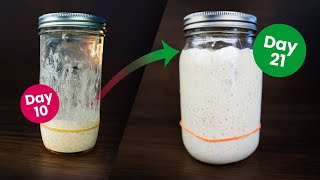
Make your own sourdough starter with flour and water and let wild yeast do the work. It suits beginners who want to bake bread without commercial yeast. You only need flour, water and a jar, plus about a week of daily feeding before the starter is ready to bake with.
YouTube video: NEW! - How to Create a Sourdough Starter : Step by Step
YouTube’s video details do not confirm captions. Check CC in the player for available tracks.
- Video length
- 51 min 34 s
- Time to do it
- 9 days
- Difficulty
- Easy
- Steps
- 7
What you need
Steps
Mix equal amounts of flour and water in a jar to make a thick, sticky paste. A common starting point is 50 g flour and 50 g water.
Loosely cover the jar so air can get in but the surface does not dry out. A lid set ajar or a cloth works well.
Leave the jar at room temperature, around 21 to 24 C, away from direct sun.
Stir the starter at least once a day during the first three days. If it looks dry on top, add a spoonful of water while stirring.
Watch for bubbles and a rise over the first days. This shows the wild yeast and bacteria are active.
Once it bubbles and rises, feed it daily by discarding most of it and adding fresh flour and water in equal amounts.
Keep feeding once a day until the starter doubles in size within about 24 hours of a feeding. Then it is ready to bake with.
Tips and common mistakes
Use non-chlorinated water, since chlorine can slow the wild yeast.
Whole grain flour feeds a new starter faster than white flour alone.
A thin dark liquid on top is normal and can be stirred back in or poured off.
If the starter does not peak within 24 hours after feeding, give it more days of regular feeding before baking.
Questions
How long does a sourdough starter take?
Most starters need about 7 to 9 days of daily feeding before they rise reliably. Cooler rooms can slow this down.
What flour and water should I use?
Whole grain or all-purpose flour works well, and non-chlorinated water is best. Avoid water straight from a softener or with heavy chlorine.
How do I know the starter is ready?
It is ready when it doubles in size within about 24 hours of a feeding and looks bubbly and active.
The notes are drafted automatically from video details and general task knowledge. How the guide was prepared
Report a correction